


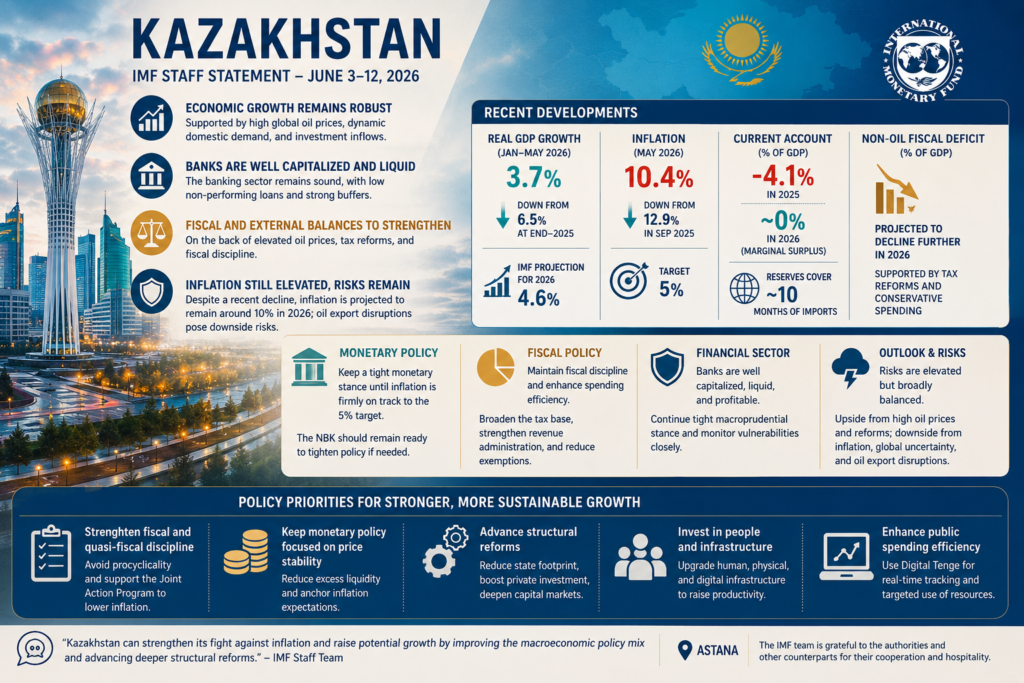
- Economic growth remains robust, supported by high global oil prices, dynamic domestic demand, and investment inflows. Banks are well capitalized and liquid. Still-elevated inflation despite a recent decline and risks of disruption to oil exports weigh on the outlook.
- Fiscal and external balances are projected to strengthen on the back of elevated oil prices. Fiscal discipline and enhanced spending efficiency are key to support the Government’s Joint Action Program to lower inflation.
- Monetary policy should stay focused on bringing inflation to target through a tight monetary stance, supported by quasi fiscal spending discipline that avoids procyclicality.
Astana: An International Monetary Fund (IMF) staff team led by Amina Lahreche visited Kazakhstan during June 3-12, 2026, to discuss recent economic developments, the outlook, and policy priorities. At the conclusion of the mission, Ms. Lahreche issued the following statement:
“Economic growth has moderated, due to lower oil production following a force-majeure accident at the CPC, with real GDP expanding by 3.7 percent in the first five months of 2026, down from 6.5 percent at end-2025. Robust performance in services, transport, construction, and manufacturing helped offset lower oil production in early 2026. The IMF team projects growth at about 4.6 percent in 2026, as elevated oil prices counterbalance the stabilization of oil output, the slowdown of household credit growth, and ongoing fiscal consolidation.
“With inflation still well above target, the monetary stance should remain tight until inflation is firmly on track toward the 5 percent target. Following the decline in inflation from 12.9 percent in September 2025 to 10.4 percent in May 2026, and the tightening of liquidity, the National Bank of Kazakhstan (NBK) reduced the policy rate by 100 basis points in June 2026. Inflation is projected to remain around 10 percent this year, with expectations still weakly anchored. External price pressures, acceleration of quasi-fiscal activities and capital spending in the second half of the year, and continued utility price adjustments pose upward risks. Planned measures to reduce excess liquidity, including higher reserve requirements and increased issuance of NBK notes, are essential to ease inflation pressures over time, and should be supported by a tighter stance in quasi-fiscal activities to avoid overheating. The NBK should stand ready to tighten monetary policy if inflation does not continue on a firmly downward trajectory.
“The fiscal and external positions are expected to improve, supported by higher oil prices and tax reforms. The non-oil fiscal deficit is projected to decline further in 2026 with the implementation of the new tax codes and conservative spending. Efforts to broaden the tax base, strengthen revenue administration through digitalization, and reduce exemptions are welcome and should support fiscal consolidation.
“The current account is expected to shift from a deficit of 4.1 percent of GDP in 2025 to a marginal surplus in 2026, as stronger exports offset import demand linked to public investment. International reserves are ample, covering about 10 months of imports.
“The banking sector remains sound, with banks well capitalized, liquid and profitable overall. Tighter prudential measures, including the activation of sectoral countercyclical capital buffer with respect to credit to individuals along with other measures have contributed to moderating consumer lending. Non-performing loans are low and well provisioned, and the authorities monitor asset quality closely. As part of the financial sector reforms, the new Banking Law updated the resolution framework for banks. The continued monitoring of vulnerabilities, together with the ongoing tight macroprudential stance, will be important to contain financial stability risks
“The outlook is subject to elevated but broadly balanced risks. Stronger domestic demand or higher import prices could reignite inflation and further de-anchor expectations. Global uncertainty and tighter financial conditions could weigh on investment inflows, while potential disruptions to the Caspian Pipeline Consortium pipeline pose downside risks to growth. On the upside, sustained high oil prices, if prudently managed, together with effective implementation of the Joint Action Program and well-sequenced utility tariff reforms, could strengthen fiscal and external buffers and help anchor inflation.
“Kazakhstan can strengthen its fight against inflation and raise potential growth by improving the macroeconomic policy mix and advancing deeper structural reforms. Productivity-enhancing reform priorities include reducing the state footprint, boosting private investment, deepening capital markets, and upgrading human, physical, and digital infrastructure. Stronger fiscal and quasi-fiscal discipline, enhanced public spending efficiency including through the use of Digital Tenge, which enables real-time tracking and targeted use of budgetary and National Fund resources, and a more dynamic private sector would help curb inflation and support stronger, diversified long-term growth.
“The IMF team is grateful to the authorities and other counterparts for their cooperation and hospitality.”




More Stories
Phoenix Police Investigate Double Homicide Near 16th Street and McKinley Street
IMF: Tax Avoidance Crackdowns Are Reshaping Competition for Global Business
ICC Unseals Four Taliban Arrest Warrants Over Alleged Gender Persecution in Afghanistan