


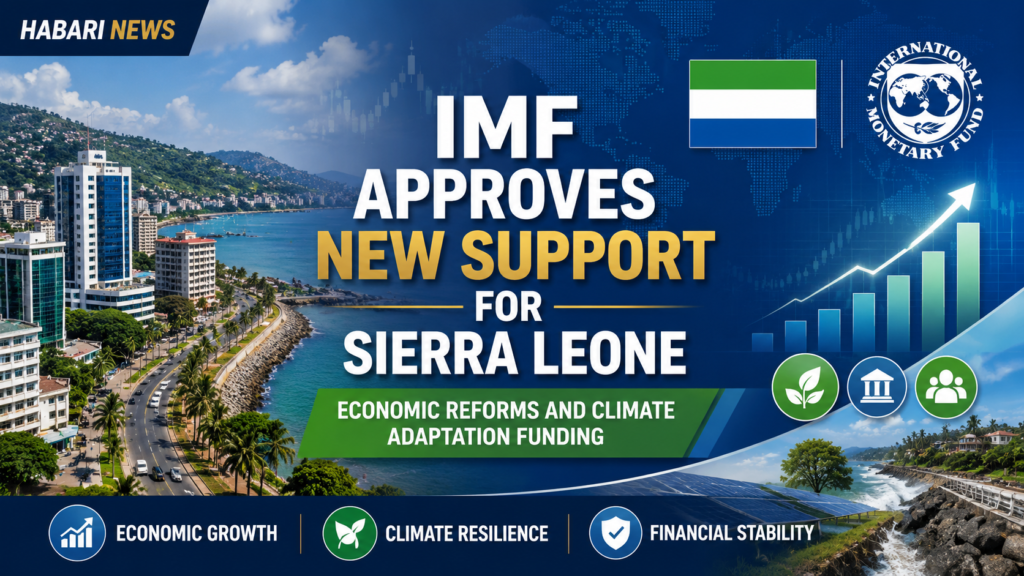
WASHINGTON, D.C. — June 10, 2026 — The International Monetary Fund (IMF) has reached a staff-level agreement with Sierra Leone on the third review of the country’s economic reform program under the Extended Credit Facility (ECF), while also supporting a new arrangement aimed at strengthening the nation’s resilience to climate change.
The agreement follows an IMF mission to Sierra Leone led by Christian Saborowski from April 20 to May 1, 2026. If approved by the IMF Executive Board in the coming weeks, the agreement will unlock continued support for Sierra Leone’s economic reform agenda and provide access to financing through the IMF’s Resilience and Sustainability Facility (RSF).
Economic Progress Continues Despite Global Challenges
According to IMF officials, Sierra Leone’s economic reforms have produced measurable results over the past year. The country’s domestic primary balance recorded a surplus of 1.3 percent of GDP in 2025, supported by increased tax revenues and spending restraint.
Combined with tighter monetary policy, these efforts have helped stabilize the national currency, reduce inflation, lower borrowing costs, and improve access to credit for businesses and consumers.
Despite global uncertainty, Sierra Leone’s economy is projected to grow by 4.0 percent in 2026. However, IMF officials noted that growth has been affected by spillover effects from the ongoing conflict in the Middle East, particularly through higher energy costs and increased economic uncertainty.
Over the medium term, growth is expected to rise toward 4.5 percent as global conditions improve and domestic reforms continue.
Fiscal Pressures and Inflation Risks Remain
While the country’s economic outlook remains generally positive, IMF staff warned that significant challenges remain.
Government revenue collections during the early months of 2026 were weaker than anticipated, while spending pressures increased. The IMF emphasized the importance of maintaining fiscal discipline while protecting critical social programs and services.
In response to rising fuel costs linked to global energy market disruptions, Sierra Leone introduced temporary fuel subsidies in April. The government has committed to keeping the measure temporary and maintaining transparency regarding its costs.
Inflation is projected to rise to approximately 11.6 percent by the end of 2026 before returning to single-digit levels by the end of 2027, according to IMF forecasts.
Officials also indicated that monetary policy may need to be tightened further if inflationary pressures persist.
Banking Sector Stable but Vulnerabilities Persist
The IMF noted that Sierra Leone’s banking sector remains profitable and generally resilient. However, vulnerabilities remain, particularly due to banks’ exposure to government debt.
Strengthening financial sector oversight and improving regulatory safeguards remain key priorities to ensure long-term financial stability and support private-sector growth.
Climate Resilience at the Center of New IMF Support
A major component of the agreement is Sierra Leone’s request for support under the IMF’s Resilience and Sustainability Facility.
The proposed RSF arrangement is designed to help the country address the growing economic impacts of climate change through reforms focused on climate-sensitive public investment management, climate resilience planning, and financial stability.
IMF officials believe the program could help attract additional international financing for climate adaptation and sustainable development projects while strengthening Sierra Leone’s long-term economic resilience.
Risks to the Outlook
Despite recent progress, the IMF highlighted several risks that could affect Sierra Leone’s economic outlook, including:
- A prolonged conflict in the Middle East
- Climate-related disasters and weather shocks
- Reform fatigue and implementation challenges
- Election-related uncertainties
- Continued global economic volatility
To address these risks, the IMF recommends continued fiscal consolidation, stronger tax collection efforts, improved debt management practices, monetary policy reforms, and implementation of governance and anti-corruption recommendations.
Meetings with Sierra Leonean Leaders
During the mission, IMF officials met with President Julius Maada Bio, Finance Minister Sheku Ahmed Fantamadi Bangura, Bank of Sierra Leone Governor Ibrahim Stevens, senior government officials, civil society organizations, private-sector representatives, and international development partners.
The IMF described the discussions as productive and reaffirmed its support for Sierra Leone’s efforts to strengthen economic stability while preparing for future climate and global economic challenges.
If approved by the IMF Executive Board, the agreements are expected to provide Sierra Leone with additional resources and policy support as the country continues its economic reform and climate resilience agenda.



More Stories
Phoenix Police Investigate Double Homicide Near 16th Street and McKinley Street
IMF: Tax Avoidance Crackdowns Are Reshaping Competition for Global Business
ICC Unseals Four Taliban Arrest Warrants Over Alleged Gender Persecution in Afghanistan