


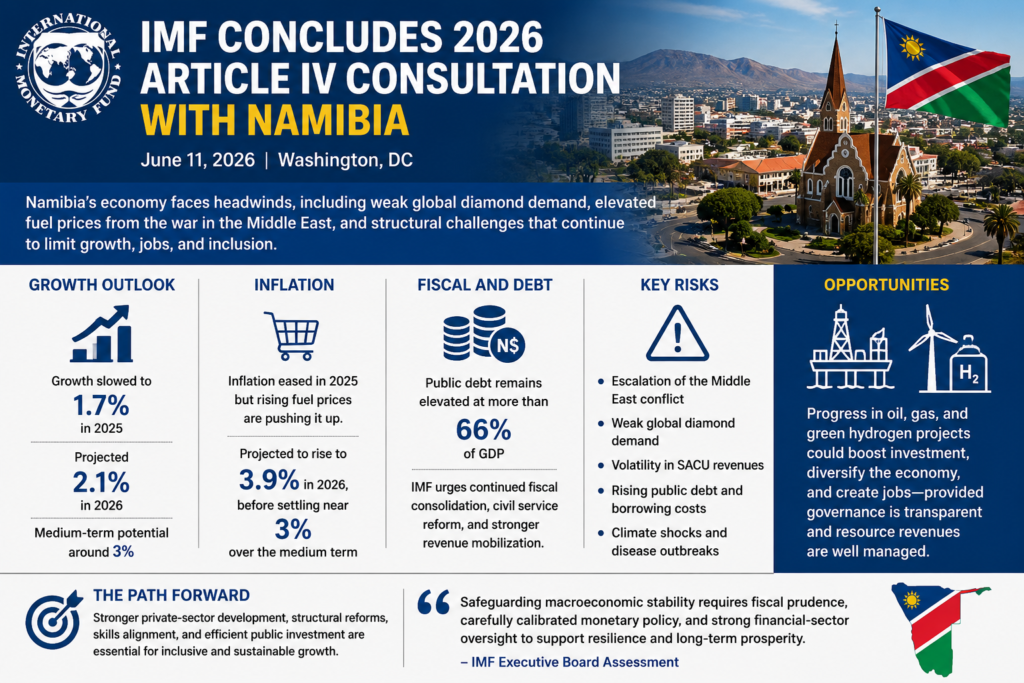
WASHINGTON, D.C. (June 11, 2026) — The International Monetary Fund (IMF) has concluded its 2026 Article IV Consultation with Namibia, warning that the country’s economy faces mounting challenges from weak global diamond demand, elevated fuel costs linked to the conflict in the Middle East, and persistent structural barriers that continue to limit job creation and economic diversification.
According to the IMF, Namibia’s economic growth slowed to 1.7% in 2025, largely due to prolonged weakness in the diamond industry, declining oil exploration activity, and a gradual recovery in gold and livestock production. While strong uranium output and growth in the services sector helped offset some losses, overall economic performance remains below levels needed to significantly reduce unemployment, poverty, and inequality.
The IMF projects Namibia’s economy will grow by 2.1% in 2026, with growth gradually recovering to approximately 3% over the medium term. However, officials noted that policy uncertainty, regulatory bottlenecks, skills mismatches, and an oversized public sector continue to hinder productivity and employment growth.
Inflation Pressures Return
Inflation eased significantly throughout 2025 thanks to lower global food prices and earlier reductions in fuel costs. However, rising fuel prices connected to the ongoing conflict in the Middle East are now putting upward pressure on consumer prices.
The IMF expects inflation to rise modestly to 3.9% in 2026 before settling near 3% in subsequent years.
Debt and Fiscal Challenges
The IMF praised Namibia’s commitment to fiscal consolidation but emphasized that additional reforms will be necessary to place public debt on a sustainable path.
Public debt remains elevated at more than 66% of GDP, while government expenditures continue to outpace revenues. IMF officials urged authorities to pursue civil service reforms, improve public enterprise oversight, strengthen public financial management, and increase revenue collection efficiency.
The Fund also highlighted the importance of implementing legislation for the proposed Welwitschia Fund, which is intended to manage future resource revenues responsibly.
Oil, Gas, and Green Hydrogen Offer Opportunity
Despite the near-term challenges, the IMF identified significant upside potential from Namibia’s emerging oil, gas, and green hydrogen sectors.
Officials stated that future investment decisions in these industries could boost growth, create jobs, and help diversify the country’s economy. However, they cautioned that success will depend on transparent governance, effective local-content policies, workforce development, and sound management of future resource revenues.
Risks Remain
The IMF warned that risks remain tilted to the downside. Potential threats include:
- Further escalation of the conflict in the Middle East
- Continued weakness in global diamond demand
- Volatility in Southern African Customs Union (SACU) revenue transfers
- Rising public debt and borrowing costs
- Climate-related shocks
- Potential outbreaks of foot-and-mouth disease affecting livestock production
At the same time, faster progress on major energy projects and stronger structural reforms could provide a significant boost to economic growth and investment.
Looking Ahead
While Namibia has demonstrated resilience amid global economic uncertainty, the IMF stressed that stronger private-sector development, regulatory reform, workforce training, and economic diversification will be essential if the country hopes to achieve sustainable and inclusive growth.
The report concludes that Namibia’s long-term success will depend not only on managing today’s economic challenges but also on preparing for future opportunities in energy, infrastructure, and industrial development.




More Stories
Phoenix Police Investigate Double Homicide Near 16th Street and McKinley Street
IMF: Tax Avoidance Crackdowns Are Reshaping Competition for Global Business
ICC Unseals Four Taliban Arrest Warrants Over Alleged Gender Persecution in Afghanistan