




Texas erased a 20-point fourth-quarter deficit against No. 1 Ohio State, Oklahoma State stunned Oregon, and Michigan reentered the national conversation during a Saturday that reshaped the College Football Playoff race.
By Habari Sports Staff
AUSTIN, Texas — For three quarters, Ohio State looked every bit like the No. 1 team in the country.
The Buckeyes controlled the football game, quieted more than 105,000 fans at Darrell K Royal-Texas Memorial Stadium, and carried a commanding 23-3 lead into the fourth quarter. Texas quarterback Arch Manning had struggled to consistently move the offense, and the fourth-ranked Longhorns appeared headed toward another painful loss to Ohio State.
Then everything changed.
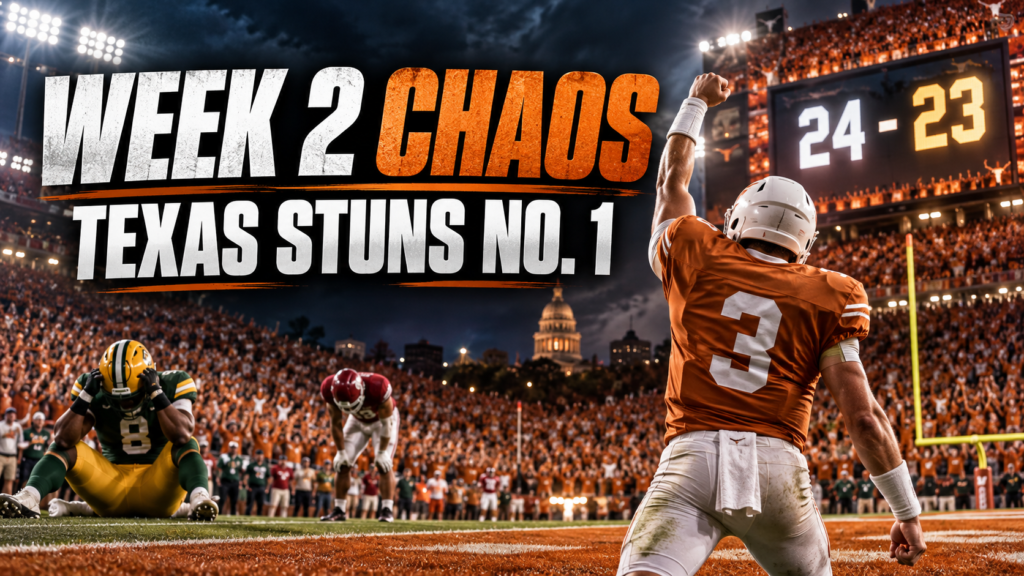
Manning directed three consecutive touchdown drives in the fourth quarter, and Hollywood Smothers launched himself over the goal line with 25 seconds remaining to complete a stunning 24-23 Texas victory.
It was the largest fourth-quarter comeback ever recorded against an Associated Press No. 1 team. Before Saturday, teams holding the No. 1 ranking were 197-0 over the past 22 years when leading by at least 20 points in the fourth quarter.
Texas turned that record into 197-1.
The comeback immediately became the defining moment of Week 2—and possibly the defining moment of the early 2026 season. But the drama in Austin was only part of a chaotic Saturday that included Oklahoma State’s monumental upset of Oregon, Michigan’s defensive victory over Oklahoma, and several performances that could dramatically reorder the national rankings.
By the end of the night, the top of college football looked nothing like it did when the weekend began.
Arch Manning delivers his signature moment
Manning entered the fourth quarter facing the kind of pressure that comes with carrying one of the most famous names in football.
Texas trailed 23-3. Ohio State’s defense had dictated the game. The Longhorns had produced only a field goal through three quarters, and every unsuccessful possession added another layer of urgency.
Manning responded with his best football of the night.
Texas opened the fourth quarter by finishing a 15-play, 91-yard drive that lasted 6 minutes, 28 seconds. Manning connected with Ryan Wingo on a 3-yard touchdown pass, cutting the deficit to 23-10 and giving the Longhorns their first real momentum of the game.
The drive did more than put seven points on the scoreboard. It established that Texas could protect Manning, move the chains, and finish in the red zone against one of the nation’s most talented defenses.
The Longhorns struck again on their next possession.
Manning led a 13-play, 72-yard drive, and Smothers scored from 1 yard out with 7:14 remaining. Suddenly, Ohio State’s 20-point advantage had been reduced to six.
The Buckeyes had an opportunity to halt the comeback, but a missed 45-yard field-goal attempt left the door open. Manning and the Texas offense walked through it.
Facing the biggest drive of his college career, Manning moved the Longhorns down the field again. Smothers finished the comeback by leaping over the pile for his second 1-yard touchdown, and Gianni Spetic converted the extra point to put Texas ahead 24-23.
Ohio State received one final possession, but Julian Sayin’s last pass was intercepted, completing a collapse that had seemed impossible less than one quarter earlier.
Manning finished with 195 passing yards, one touchdown, and one interception. Those numbers do not completely explain his impact. After an uneven start, he reportedly completed 11 of his final 15 passes and repeatedly delivered with the game—and Texas’s championship expectations—hanging in the balance.
This was not a flawless Manning performance. It was something more revealing: a resilient one.
He did not dominate Ohio State from the opening snap. He struggled, adjusted, and then played his best football when Texas could no longer afford another empty possession. That response will matter as much as the final score when coaches evaluate whether Manning is prepared to lead the Longhorns through an unforgiving SEC schedule.
Ohio State’s collapse raises difficult questions
Ohio State quarterback Julian Sayin threw for 278 yards, while star receiver Jeremiah Smith caught eight passes for 164 yards and a touchdown. The Buckeyes built a 20-3 halftime advantage and extended the lead to 23-3 during the third quarter.
For most of the game, they had the correct formula.
Ohio State pressured Manning, generated explosive plays through Smith, and prevented Texas from establishing an offensive rhythm. But the Buckeyes failed to score in the fourth quarter and could not produce the one drive needed to finish the game.
That is what will make this loss so difficult to absorb.
Ohio State did not spend four quarters chasing Texas. It controlled the matchup and still lost. The defense surrendered three long touchdown drives in the final period, while the offense could not answer after Texas found its rhythm.
The missed field goal was costly, but it was not the only reason Ohio State lost. The Buckeyes allowed Texas to run 41 plays across three consecutive touchdown possessions. When the game demanded one defensive stand, Ohio State could not get off the field.
The defeat should not eliminate the Buckeyes from the College Football Playoff race. The expanded playoff gives elite teams room to recover from an early nonconference loss, especially one on the road against a top-five opponent.
But Ohio State has lost control of the national conversation. The Buckeyes will fall from No. 1, and their margin for error has narrowed considerably.
Texas, meanwhile, is positioned to climb from No. 4 to the top of the AP poll. No. 2 Georgia and No. 3 Notre Dame delivered dominant victories, but neither can match the strength or drama of Texas beating the nation’s top-ranked team.
Oklahoma State produces the weekend’s biggest upset
If Texas delivered the most dramatic victory of Saturday, Oklahoma State produced the most improbable.
The Cowboys entered their game against No. 6 Oregon carrying a 21-game losing streak against FBS opponents. Oklahoma State had finished 1-11 the previous season, replaced longtime coach Mike Gundy and opened the Eric Morris era with a 24-10 loss to Tulsa.
Oregon arrived in Stillwater as a 23½-point favorite.
None of it mattered.
Oklahoma State stunned the Ducks 39-31 behind an extraordinary performance from transfer quarterback Drew Mestemaker, who threw for 317 yards and two touchdowns while rushing for 109 yards and another score.
The final yardage told the story: Oklahoma State outgained Oregon 554-281. The Cowboys more than doubled the Ducks’ offensive production and controlled the ball for nearly 37 minutes.
Mestemaker established the tone immediately with a 75-yard run on Oklahoma State’s first offensive play. He repeatedly attacked Oregon through the air, including a 52-yard touchdown pass to Wyatt Young that helped the Cowboys build a 24-17 halftime lead.
Oregon briefly reclaimed the advantage when Dante Moore connected with Evan Stewart for a 38-yard touchdown early in the fourth quarter. The score gave the Ducks a 31-30 lead and appeared to restore order.
Mestemaker answered with the drive of the game.
He directed Oklahoma State 75 yards in 12 plays before scoring on a 10-yard run, launching himself through defenders and into the end zone. The Cowboys later added a field goal after stopping Oregon on fourth down.
Fans stormed the field and eventually carried a goalpost into Theta Pond, celebrating a victory that felt like the beginning of an entirely new era in Stillwater.
Oklahoma State’s turnaround changes the program’s trajectory
One upset cannot erase a 1-11 season or guarantee that Oklahoma State will contend for the Big 12 championship. It can, however, transform the belief surrounding a rebuilding program.
Morris rebuilt the Cowboys’ roster with 88 new players, and Mestemaker followed him from North Texas. After the disappointing loss to Tulsa, questions immediately surfaced about how long the rebuild might take.
The answer may be considerably less time than expected.
Oklahoma State played faster, more confidently, and more physically than Oregon. The Cowboys accumulated 237 rushing yards, converted long drives, and refused to unravel after two tipped passes resulted in interceptions.
Oregon’s defense scored one touchdown and set up another with a return to the Oklahoma State 1-yard line. Despite those potentially crushing mistakes, the Cowboys remained aggressive.
For Oregon, the performance was alarming.
The Ducks entered the season ranked No. 2 but looked vulnerable in their opening victory over Boise State. Against Oklahoma State, those warning signs became a full-scale problem.
Oregon generated only 12 first downs and 281 total yards. Moore finished 14-of-21 for 191 yards and two touchdowns, but the Ducks struggled to sustain possessions and were overwhelmed at the line of scrimmage.
The loss will likely send Oregon tumbling out of the top 10. More importantly, the Ducks must now prove that their preseason championship expectations were based on more than roster talent and reputation.
Michigan rediscovers its identity
Michigan’s 17-10 victory over No. 11 Oklahoma was not as explosive as Texas’s comeback or as shocking as Oklahoma State’s upset.
It may have been just as important.
After a difficult opening week, the Wolverines returned to the formula that has defined their best teams: defense, physicality, and patience.
Michigan limited Oklahoma to 10 points, forced critical mistakes, and kept the Sooners from turning the game into an offensive shootout. Rather than asking its offense to win possession after possession, Michigan controlled the matchup by making every Oklahoma drive difficult.
The Wolverines’ offense did enough. Their defense did the rest.
In an era dominated by quarterback statistics and explosive passing attacks, Michigan demonstrated that a championship-caliber defense can still dictate the terms of a major game. The Wolverines are not a finished product, particularly on offense, but beating a ranked Oklahoma team places them firmly back in the national discussion.
Michigan could return to the AP Top 25 after the victory. Oklahoma, meanwhile, will likely fall from No. 11 after failing to consistently solve the Wolverines’ defense.
Iowa keeps the Cy-Hawk Trophy
No. 21 Iowa defeated Iowa State 16-13 in a rivalry game that looked exactly like a Cy-Hawk matchup: physical, tense, and decided by special teams.
Iowa State opened a 10-0 advantage in the second quarter before the Hawkeyes scored 10 consecutive points to tie the game by halftime. The Cyclones moved back in front on Kyle Konrardy’s 51-yard field goal in the third quarter, but Iowa kicker Caden Buhr took over from there.
Buhr connected from 32 yards to tie the game with 6:22 remaining. After Iowa’s defense forced a three-and-out, quarterback Hank Brown led a nine-play drive that used 4:13 of the final 4:28.
With 15 seconds remaining, Buhr made a 42-yard field goal to give Iowa the victory.
He finished 3-for-3 on field goals, also converting from 45 yards before halftime.
Brown completed 21 of 30 passes for 191 yards and helped Iowa recover from its early deficit. The Hawkeyes’ defense allowed Iowa State only eight yards during the fourth quarter, allowing the offense and Buhr to win the game late.
It was not a dominant performance from Iowa, but rivalry games rarely require style points. The Hawkeyes protected their ranking and kept the Cy-Hawk Trophy by winning the situational moments that mattered most.
Georgia and Notre Dame handle business
While several contenders struggled, Georgia and Notre Dame avoided the chaos.
No. 2 Georgia overwhelmed Western Kentucky 70-20 behind five touchdown passes from Gunner Stockton. The Bulldogs improved to 2-0 and strengthened their argument for the No. 1 ranking, although Texas’ victory over Ohio State gives the Longhorns the weekend’s most impressive résumé.
Georgia showed the depth and offensive balance expected from a national championship contender. The Bulldogs scored 70 points without needing a dramatic finish, eliminating any possibility of allowing the weekend’s upset wave to reach Athens.
No. 3 Notre Dame was equally convincing in a 52-0 shutout of Rice.
Quarterback CJ Carr accounted for four touchdowns, while the Fighting Irish built a 42-0 halftime advantage. Notre Dame threw for 360 yards and recovered four fumbles, combining offensive efficiency with an opportunistic defensive performance.
The Irish still have questions surrounding a running game that averaged only 3.7 yards per carry, but a 52-point victory offers plenty of room for correction.
Texas may jump to No. 1, but Georgia and Notre Dame remain positioned directly behind the Longhorns.
Alabama responds after early trouble
No. 12 Alabama trailed Kentucky at halftime before responding with a dominant second-half performance and a 45-17 victory.
The final score suggests a routine Alabama win. The path to that result was more complicated.
Kentucky’s early success exposed areas that Kalen DeBoer and his staff will need to address, but Alabama’s response demonstrated the talent gap that still separates the Crimson Tide from many opponents.
Instead of allowing the halftime deficit to produce panic, Alabama increased its physicality and took control after the break. The Crimson Tide scored repeatedly, shut down Kentucky’s momentum and turned a potential upset into a comfortable victory.
For Alabama, the second half was encouraging. The first half was a warning.
What Week 2 means for the rankings
Texas has the clearest path to No. 1.
The Longhorns are 2-0 and now own the strongest victory of any leading contender. Georgia and Notre Dame were dominant, but Texas defeated the defending No. 1 team after completing the largest fourth-quarter comeback ever against an AP top-ranked opponent.
The top of the next poll should include some combination of Texas, Georgia, and Notre Dame.
Ohio State will fall but should remain inside or near the top 10. A one-point road loss to Texas is damaging, but it is not comparable to Oregon losing as a three-touchdown favorite against a team riding a 21-game FBS losing streak.
Oregon’s fall should be much steeper. Michigan could return to the rankings, while Oklahoma State deserves serious consideration after delivering the season’s biggest upset.
Iowa survived but may not move much after being pushed to the final seconds by an unranked rival. Oklahoma will fall after its 17-10 loss, and the middle of the poll could experience significant movement as voters reassess early expectations.
The College Football Playoff picture
The expanded playoff format prevents one September loss from ending a championship run, but Week 2 still altered the postseason landscape.
Texas now has a marquee nonconference victory that could become invaluable during playoff seeding discussions. Even if the Longhorns stumble during SEC competition, beating Ohio State gives them a powerful résumé anchor.
Ohio State remains a contender but must respond. The Buckeyes can recover through Big Ten play, though another loss would create far more pressure.
Oregon faces the most difficult road. Losing to an unranked opponent is damaging by itself; losing while being outgained by 273 yards makes the result harder to dismiss as a fluke.
Michigan’s victory gives the Wolverines life. Oklahoma State’s win transforms the Cowboys from an afterthought into one of the Big 12’s most intriguing teams. Georgia and Notre Dame remain firmly positioned among the early championship favorites.
Week 2 did not decide the playoff field.
It did reveal which teams could handle adversity—and which ones were not prepared for it.
Final word
College football often spends the offseason building certainty. Teams are ranked, projected, and analyzed before they have played a meaningful snap.
Then a Saturday like this arrives.
Ohio State entered the fourth quarter with a 20-point lead and left Austin without the No. 1 ranking. Oregon arrived in Stillwater as a national championship contender and departed after one of the most embarrassing defeats in recent program history. Michigan reestablished its defensive identity. Iowa survived its rival. Georgia and Notre Dame delivered statements without drama.
And at the center of it all was Arch Manning.
With Texas’ season threatening to absorb an early blow, Manning stopped looking like a quarterback trying to fulfill enormous expectations. For one quarter, he simply looked like the quarterback capable of meeting them.
Three drives. Three touchdowns. One historic comeback.
Week 2 belonged to Texas—and the rest of college football will spend the coming weeks trying to catch up.
Reporting was verified against official school statistics and national coverage from Texas Athletics, Oklahoma State Athletics, Iowa State Athletics, the NCAA, and Reuters.




More Stories
Idaho Stuns No. 1 Montana State, Earns Pop-Tarts Bowl Team of the Week Honor
Florida Earns Pop-Tarts Bowl Team of the Week After 52-28 Win Over No. 4 Ole Miss
Texas’ Colin Simmons Earns Bronko Nagurski Honor After Record 5.5 Sacks