




Habari Entertainment | October 1, 2026
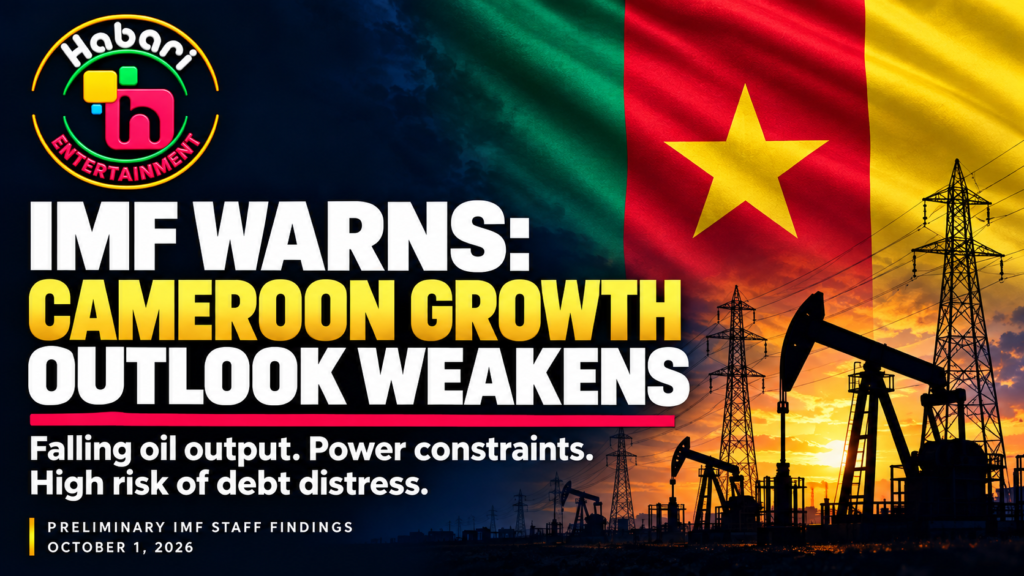
YAOUNDÉ, Cameroon — Cameroon’s economy grew 3.5% in 2025, but declining hydrocarbon production and electricity transmission constraints are weighing on its outlook for 2026, according to preliminary findings from an International Monetary Fund staff mission.
The assessment follows discussions in Yaoundé from September 17–30, led by Christine Dieterich. The team met with government officials, the central bank, civil society, businesses, banks, and development partners as part of Cameroon’s Post-Financing Assessment.
IMF staff called for tighter fiscal policy, stronger domestic revenue collection, and faster structural reforms to protect economic stability. They also warned that Cameroon remains at a high overall risk of debt distress.
Oil and electricity constraints weigh on growth
Cameroon’s 3.5% growth in 2025 matched its performance in 2024. While the services sector continues to show strength, IMF staff expect a slight slowdown in 2026 as hydrocarbon production declines and delays persist in expanding electricity transmission capacity.
The mission did not provide a specific growth forecast for 2026 in its statement.
The electricity constraint highlights a challenge for the country’s economic outlook: expanding productive activity depends partly on the infrastructure needed to reliably transmit power.
Food prices threaten progress on inflation
Average inflation declined to 2.6% through August 2026, according to the mission. However, staff expect that downward trend to reverse as food-price pressures accelerate.
That outlook raises concerns for household purchasing power, particularly for families whose budgets are heavily concentrated on necessities.
The statement did not provide a full-year inflation projection or specify how sharply food prices are expected to rise.
Budget deficit widens as fuel subsidies add pressure
Cameroon’s overall fiscal deficit increased from 1.5% of GDP in 2024 to 2.1% in 2025.
IMF staff expect a modest further deterioration in 2026, with an international oil-price shock generating sizeable fuel subsidies.
The mission’s findings point to pressure on two fronts: declining hydrocarbon production is weakening growth prospects, while fuel subsidies are adding to government spending.
Staff also identified international capital-market conditions, slow reform implementation, and continuing security and climate challenges as downside risks.
High debt risk prompts calls for fiscal reforms
The IMF staff assessment places Cameroon at high overall risk of debt distress. That classification signals significant debt vulnerabilities; it does not, by itself, mean the country has defaulted.
To preserve macroeconomic stability, the mission recommended fiscal tightening, stronger collection of domestic revenues, and mobilization of concessional financing—funding offered on more favorable terms than conventional market borrowing.
Staff said those measures should be accompanied by reforms that support growth, including stronger governance of public spending, better management of state-owned enterprises, and development of the financial sector.
Together, those priorities focus on improving how public resources are raised and used while strengthening the economy’s ability to support investment and growth.
IMF Board discussion expected in December
Cameroon’s 2026 Post-Financing Assessment is expected to be discussed by the IMF Executive Board in December 2026.
A Post-Financing Assessment examines a country’s policies, economic framework, and capacity to repay the IMF when outstanding credit exceeds specified thresholds, and the country does not have an IMF-supported or staff-monitored program.
The October 1 statement contains preliminary staff findings. These do not necessarily represent the Executive Board’s views. Staff will prepare a report for Board consideration, subject to IMF management approval.
The mission’s statement does not announce a new loan approval or disbursement.
Source: IMF end-of-mission statement dated October 1, 2026, supplied for this article.




More Stories
74-Year-Old Man Dies in St. Louis County House Fire; Investigation Underway
Two Arrested After Vehicle Crashes Through Scottsdale Airport Gate and Strikes Plane
Phoenix Man Arrested After Woman’s Body Found in Dumpster Near 57th Avenue and Thomas Road