





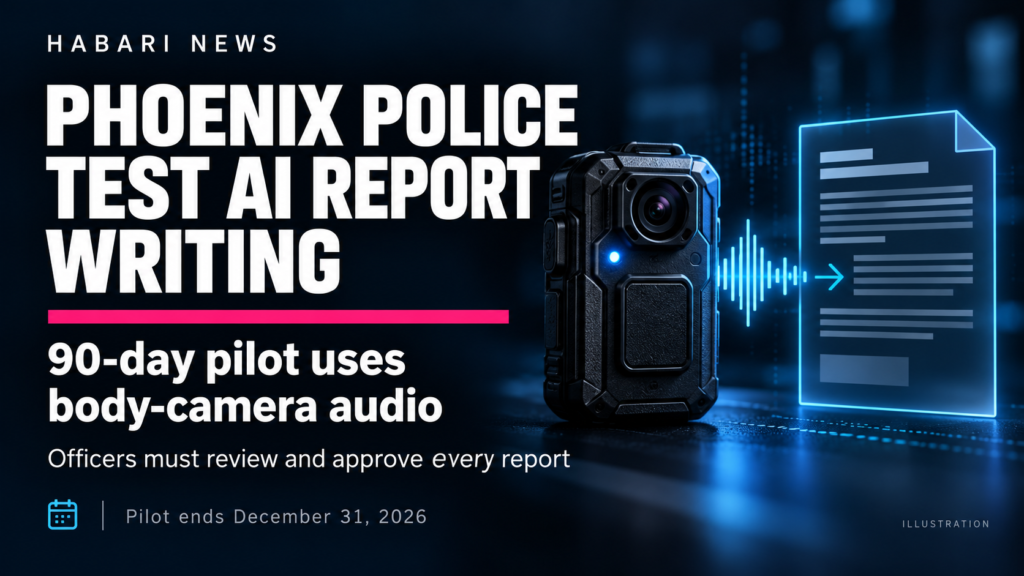
PHOENIX — The Phoenix Police Department has launched a 90-day pilot of an artificial intelligence tool that drafts police reports using body-worn camera audio, testing whether the technology can reduce paperwork and give officers more time to respond to calls and work in neighborhoods.
The program was requested by Councilwoman Ann O’Brien, who chairs the City’s Public Safety and Justice Subcommittee. According to the city’s announcement, officers must review and correct every draft before it enters the department’s records system.
O’Brien pointed to staffing shortages as a reason to explore the technology, saying time spent writing reports limits officers’ availability for other duties. She said the pilot will allow the department to evaluate results before deciding whether to expand its use.
Where the Technology Is Being Tested
The pilot includes patrol officers in the Mountain View Precinct, the Family Investigations Bureau and the Assaults Unit within the Violent Crimes Bureau, according to the announcement.
For patrol operations, the department will track overtime, response times, calls answered, arrests, body-camera activation rates, and report-writing time.
For investigations, it will measure case-management overtime, call-out overtime, case disposition and the time needed to write reports. Those measures will help the department determine how the tool performs in Phoenix.
Officers Remain Responsible for Reports
The tool, Axon DraftOne, generates a draft narrative from transcribed audio recorded by an officer’s body-worn camera. The process begins after the camera is turned off and its encrypted footage is uploaded.
Officers must then edit and correct the draft. Before the report can enter the department’s records management system, the officer must sign an attestation confirming that it accurately represents their recollection of events.
The city says drafts can only be generated from transcribed audio of actual recordings. The technology produces an initial narrative; the officer remains responsible for reviewing and approving the report.
Results Will Guide Any Expansion
The pilot ends December 31, 2026. Afterward, Phoenix police will assess the results and decide whether to evaluate the technology further or move toward department-wide use.
The announcement does not establish that the tool has already reduced paperwork or improved response times. Those potential benefits are what the pilot is intended to test.
Source: City of Phoenix, Councilwoman Ann O’Brien’s office.




More Stories
Man Dies After Phoenix Police Shooting at Sunland Avenue Apartment Complex
Missing 9-Year-Old Zhy’Lan Green Found Safe, Phoenix Police Confirm
Man Dies After Hit-and-Run Collision on Northern Avenue in Phoenix