


By Habari News
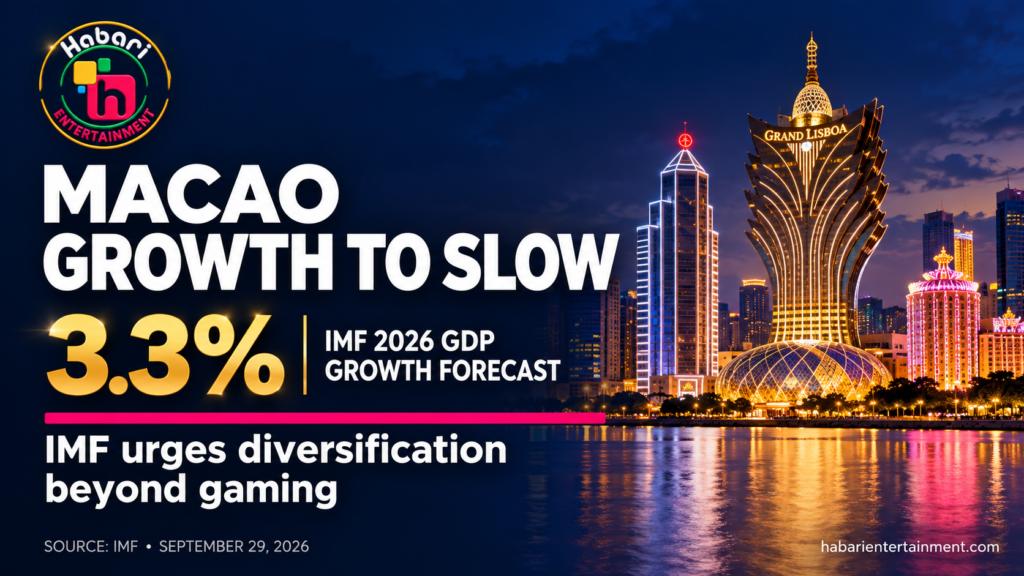
WASHINGTON | September 29, 2026 — Macao’s economy remains resilient, but its dependence on gaming and tourism is leaving the recovery uneven, according to the International Monetary Fund. The institution projects real GDP growth to slow to 3.3% in 2026, down from an estimated 4.7% in 2025.
The IMF Executive Board concluded its 2026 Article IV consultation with China’s Macao Special Administrative Region on September 24, endorsing the staff appraisal without a formal meeting under its lapse-of-time procedure.
The assessment calls for stronger domestic demand, better execution of public spending and sustained investment in economic diversification.
Tourism Recovery Has Not Lifted All Parts of the Economy
Visitor arrivals surpassed pre-pandemic levels in 2025, supporting gaming and tourism activity. Gaming revenue, however, remained below its pre-pandemic peak.
The IMF attributed that gap to regulatory changes, stronger anti-money-laundering and counter-terrorist-financing enforcement, and shifts in visitor spending.
The tourism rebound has also failed to produce a broad-based recovery in domestic demand. Total domestic demand fell an estimated 0.6% in 2025, while investment declined 7.8%.
Still-tight credit conditions, uncertainty, property-market weakness and incomplete execution of public spending have restrained investment, the IMF said.
Growth Slows as Inflation Picks Up
The IMF projects growth of 3.1% in 2027, followed by gradual moderation toward 3% over the later years of its forecast. The outlook reflects expected slower growth in mainland China and Hong Kong.
Average headline inflation is projected to increase from 0.3% in 2025 to 1.8% in 2026 and 1.9% in 2027. The IMF expects prices to rise somewhat faster as economic slack narrows and the effects of lower import prices from mainland China fade.
| Indicator | 2025 estimate | 2026 projection | 2027 projection |
|---|---|---|---|
| Real GDP growth | 4.7% | 3.3% | 3.1% |
| Total domestic demand growth | −0.6% | 2.8% | 3.5% |
| Investment growth | −7.8% | 4.0% | 4.3% |
| Average headline inflation | 0.3% | 1.8% | 1.9% |
| Average unemployment rate | 1.9% | 1.7% | 1.7% |
| General government surplus, share of GDP | 8.3% | 9.6% | 7.8% |
| Current account surplus, share of GDP | 39.6% | 39.7% | 39.1% |
Source: IMF selected economic and financial indicators. Future figures are projections.
Fiscal Resources Could Support Domestic Demand
The IMF said Macao has ample fiscal space to strengthen demand, support diversification and address population aging.
Its projections show total public debt at zero and fiscal reserves equivalent to 158.5% of GDP in 2026. The institution urged authorities to improve delivery of already-budgeted spending, particularly capital investment and aging-related welfare programs.
Over the medium term, it recommended a clearly defined fiscal framework linking resources to strategic priorities. Those priorities include physical and digital infrastructure, workforce development, and pension and healthcare protection.
The IMF also called for broadening the non-gaming tax base and periodically reviewing tax exemptions and incentives to ensure they are effective, well-targeted and aligned with development goals.
Diversification Target Requires Skills and Investment
Macao aims to increase non-gaming activities to 60% of GDP by 2030. Achieving that target will require further efforts to build skills, attract talent, close infrastructure gaps and improve the business environment, according to the assessment.
The IMF recommended that support—including measures funded through the envisaged MOP 20 billion Government Guidance Fund—be targeted, time-limited and tied to performance.
It also highlighted partnerships between higher education and industry, alongside opportunities from digitalization and artificial intelligence. Those efforts should include financial-integrity protections, data governance, cybersecurity safeguards and policies supporting workers through economic change.
Banking and Climate Risks Remain Priorities
The IMF described Macao’s banking system as resilient while calling for continued attention to asset quality, adequate provisions and capital buffers.
It urged stronger oversight of non-bank financial institutions and targeted support for small and medium-sized businesses, backed by better insolvency and debt-resolution frameworks.
Risks to the outlook remain tilted downward. The IMF cited geopolitical conflicts, renewed trade tensions, global financial volatility, cyber threats, competition in gaming, climate-related disasters and a prolonged property downturn.
Recommended climate measures include improved flood defenses and drainage, more resilient infrastructure and tourism facilities, stronger building standards and better emergency preparedness.
Faster diversification, deeper integration with the Guangdong-Hong Kong-Macao Greater Bay Area and investment in higher-value industries could strengthen growth and employment, the IMF said.
Source: IMF’s September 29, 2026, release on its Article IV consultation with Macao SAR. Pasted text(20261004-212214)




More Stories
ICC President Meets Belgian Ministers Over Sanctions and Court Independence
ICC Welcomes 2026 Sakharov Prize Amid Sanctions Against Court
ICC Updates Judicial Ethics Code With Social Media Rules and Binding Standards