

By Habari News | October 8, 2026
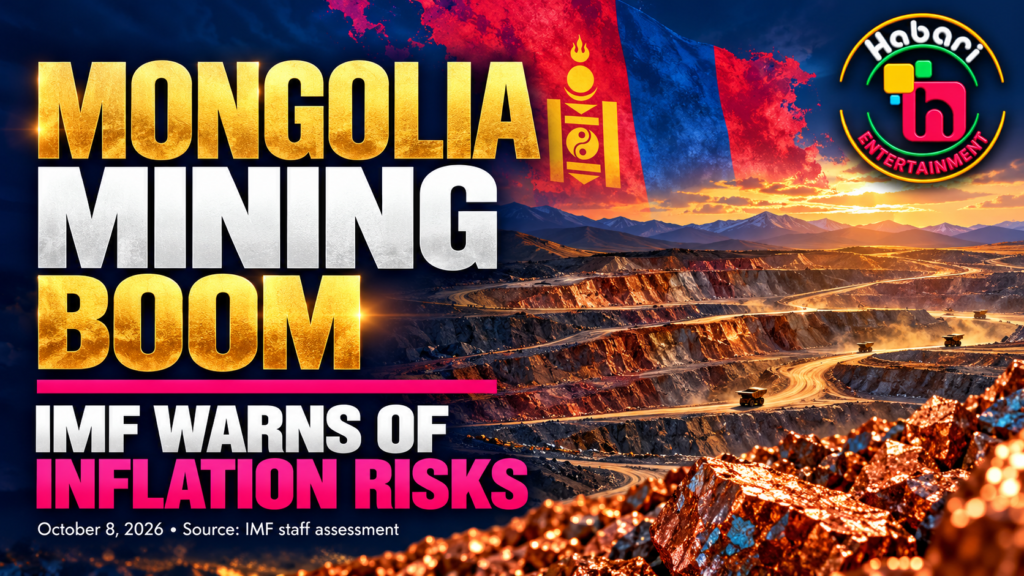
Mongolia’s mining boom is strengthening economic growth and government revenues, but proposed spending increases and tax cuts could deepen fiscal vulnerabilities and prolong high inflation, according to an International Monetary Fund staff assessment released October 8.
An IMF team led by Tahsin Saadi Sedik visited Mongolia from September 23–29 to discuss recent economic developments. Its findings highlight a growing tension: higher copper production and strong commodity prices are improving the country’s finances, while proposed budgets would commit temporary revenue gains to lasting spending obligations.
Mining Drives Stronger Growth
Mongolia’s economy expanded 7.7 percent in the first half of 2026, exceeding expectations as mining production increased. High copper and coal prices also supported exports, government revenue and the country’s external position.
Gross international reserves reached $8.9 billion by the end of September. Strong mining revenues helped balance the budget despite a 20 percent year-over-year increase in government spending through August, according to IMF staff.
The team projects 6.2 percent economic growth for the full year, with stronger mining activity offsetting weaker growth in other sectors.
Bank credit growth slowed to approximately 14 percent year over year in August, reflecting earlier monetary and macroprudential measures intended to restrain financial pressures.
Inflation Climbs to 12.9 Percent
Despite the stronger growth outlook, inflation accelerated to 12.9 percent in September, substantially above the Bank of Mongolia’s target range of 4 to 8 percent.
IMF staff attributed the increase partly to food price shocks and acute fuel shortages caused by intermittent supply disruptions. Mining operations had not been affected at the time of the assessment, but renewed disruptions remain a threat.
Underlying inflation also edged higher, and inflation expectations increased.
In August, the Bank of Mongolia raised its policy rate by half a percentage point to 12.5 percent and increased domestic reserve requirements by the same amount to 14.5 percent.
Proposed Budgets Raise Fiscal Concerns
The IMF team warned that the 2026 supplementary budget and 2027 draft budget propose a substantial fiscal expansion through tax cuts, expanded social programs, higher public wages and pensions, and increased investment.
Much of the additional spending would be financed by one-off dividends from state-owned enterprises and the Oyu Tolgoi copper mining company.
The central concern is the mismatch between permanent spending commitments and revenue that may fluctuate sharply or arrive only once. If mining income falls short, Mongolia could face pressure to make abrupt fiscal adjustments to protect economic and external stability.
IMF staff also warned that draft legislation accompanying the budget proposals would further weaken the effectiveness of fiscal rules. The proposed expansion would likely increase fiscal deficits and worsen the public debt trajectory.
Price Pressures Could Persist Through 2027
Under the policies assessed by the team, headline inflation is projected to remain around 13 percent at the end of 2026.
Food and fuel price pressures are expected to ease gradually by the end of 2027. However, rising core inflation could keep overall inflation at approximately 8.5 percent, still above the central bank’s target range.
The IMF warned that further public sector wage increases and fiscal expansion could contribute to a wage-inflation spiral, in which higher wages and prices reinforce one another.
Global and regional instability present additional risks. Renewed fuel supply disruptions or higher petroleum prices could increase inflation and weaken economic activity, particularly if shortages begin affecting mining operations.
IMF Urges Mongolia to Rebuild Financial Buffers
The team recommended directing much of the mining revenue windfall toward rebuilding fiscal buffers rather than expanding permanent spending.
It also urged authorities to reconsider the proposed tax cut package, resist additional reductions in non-mining taxes, and target spending more carefully while reducing reliance on volatile mining revenue.
On monetary policy, IMF staff called for further tightening amid elevated inflation and proposed fiscal expansion. The team noted that monetary conditions had recently eased as inflation reduced real interest rates, while nominal wages and inflation expectations increased.
The assessment also recommended promptly enacting central bank legislation to strengthen the Bank of Mongolia’s operational autonomy, accountability and effectiveness. Amendments to the Banking Law were recommended to improve governance, recalibrate shareholder limits and support effective bank management.
The findings are preliminary and represent the views of IMF staff, rather than necessarily those of the IMF Executive Board. The visit will not result in a Board discussion.
Source: IMF end-of-mission statement, “IMF Staff Team Concludes Staff Visit to Mongolia,” October 8, 2026, supplied to Habari Entertainment.



More Stories
Suspect Arrested in Phoenix Double Homicide Near 16th and McKinley Streets
IMF: Tax Avoidance Crackdowns Are Reshaping Competition for Global Business
ICC Unseals Four Taliban Arrest Warrants Over Alleged Gender Persecution in Afghanistan