




By Habari News
The International Monetary Fund has completed a major review of how it monitors member economies and delivers policy advice, outlining a stronger focus on resilience as countries confront elevated debt, artificial intelligence, climate change, and a more fragmented global economy.
In a statement released October 2, the IMF said its Executive Board concluded the 2026 Comprehensive Surveillance Review on September 17. The review establishes strategic and operational priorities for strengthening the institution’s economic surveillance in the years ahead.
The assessment examines progress since the previous comprehensive review in May 2021. It finds that IMF surveillance continues to help countries navigate difficult policy choices, while warning that frequent shocks, uncertainty, and structural changes are making economic stability harder to protect.
Three Priorities for Economic Resilience
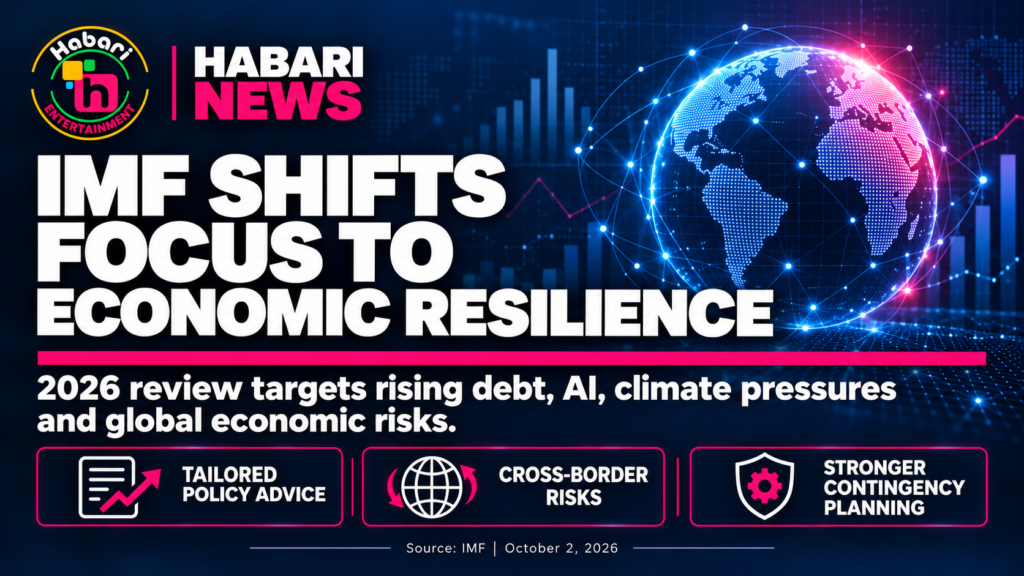
The review identifies three central priorities: more tailored advice to support resilience and growth, stronger analysis of external stability and cross-border spillovers, and better risk management through assessments and contingency planning.
The IMF defines resilience as the ability to withstand, adapt to, and recover from shocks. With debt levels elevated and governments facing constrained policy options, the review places that capacity at the center of its approach.
Executive Directors supported more detailed and integrated recommendations, including realistic debt and financing projections, stronger analysis of the relationship between financial conditions and the broader economy, and better-prioritized structural reforms.
Directors also emphasized that recommendations should reflect each country’s institutional capacity, political circumstances, and distributional impacts—the effects policies have on different groups within an economy.
Greater Attention to Trade and Cross-Border Risks
The Board supported more comprehensive, forward-looking analysis of external imbalances, capital flows, trade policies, and industrial policies. It also called for a closer examination of how domestic economic decisions affect other countries.
That focus is particularly relevant for systemically important economies, whose policies can influence the functioning of the international monetary system.
Directors said assessments should be timely, consistent, and evenhanded. They emphasized that a stronger analysis of risks spreading outward from a country should accompany continued attention to shocks arriving from abroad.
The Board endorsed the IMF’s existing approach to security-motivated policies: assessing their economic implications when those implications are significant for macroeconomic stability. A few Directors called for more systematic examination of spillovers from trade-distorting measures, including primary and secondary sanctions.
Stronger Risk Planning, Caution on Monetary Guidance
The review calls for risk assessments focused on threats capable of materially changing the IMF’s baseline policy recommendations. Directors supported more actionable contingency advice and greater use of quantitative scenarios where feasible.
They nevertheless emphasized that the baseline outlook should remain the foundation of surveillance and that staff judgment remains essential.
On monetary policy, many Directors cautioned against overly prescriptive guidance about the future direction of policy. They stressed the importance of safeguards when publishing and communicating such advice, including sensitivity to markets and national institutional arrangements.
IMF Supports AI Tools With Guardrails
Directors supported the gradual deployment of AI tools in IMF surveillance, subject to clear governance, oversight, and guardrails. The review emphasizes preserving staff judgment as those tools are introduced.
The Board also called for better use of high-quality data and analytical tools, stronger statistical capacity, and transparent acknowledgment of limitations when data gaps constrain economic assessments.
Proposed operational changes include more agile and continuous engagement, stronger regional cooperation, and closer integration of country-level surveillance, global analysis, and capacity development.
The review also proposes lengthening the Article IV consultation cycle for countries with IMF-supported programs.
Climate Coverage Draws Differing Views
Directors generally supported the proposed direction of future work on governance, gender, digital money, and AI. Climate coverage, however, drew differing views.
Most Directors expected the IMF’s Climate Strategy objectives and coverage targets for adaptation, transition, and mitigation policies to be reached, given the economic significance of climate issues. A view was also expressed that climate policies are not macrocritical in the context of individual-country surveillance.
Many Directors emphasized that climate ambition and the cross-border effects of domestic policies should remain part of global surveillance. Many also stressed the importance of maintaining climate expertise and analytical capacity.
A few Directors cautioned that work in newer policy areas should not come at the expense of traditional IMF responsibilities.
More Focused Reviews and Stronger Accountability
The review seeks to sharpen Article IV consultations by prioritizing issues most critical to domestic and balance-of-payments stability.
Directors supported clarifying the “macrocriticality” criterion—the basis for determining whether a policy issue is sufficiently important to economic stability to warrant coverage. They called for safeguards to ensure transparent, consistent, and evenhanded application.
Several Directors warned against reducing attention to issues that affect fewer countries but have severe consequences for fragile and conflict-affected states, small developing states, and highly vulnerable economies.
The Board welcomed the development of a Policy Recommendation Assessment System to track implementation, identify obstacles, and strengthen continuity of advice.
Directors cautioned that weak or uneven implementation could undermine surveillance quality and effectiveness. They called for clear priorities, accountability, and coordination across related IMF workstreams.
The next Comprehensive Surveillance Review is expected in five years.
Source: IMF statement, “IMF Executive Board Concludes the 2026 Comprehensive Surveillance Review,” released October 2, 2026. Pasted text(20261004-165544)


More Stories
IMF Projects Macao Growth to Slow to 3.3% in 2026, Urges Diversification Beyond Gaming
ICC Assembly Presidency Urges Naoero to Remain in Rome Statute Amid Withdrawal Steps
ICC Judges Agree on Ethics Updates and Proposed Disciplinary Reforms