

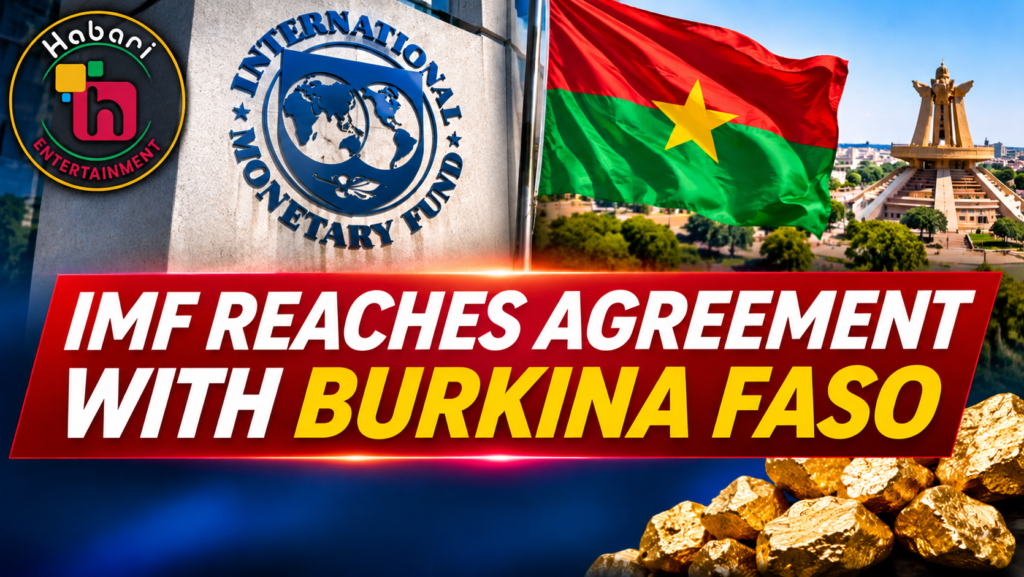
WASHINGTON, D.C. — November 4, 2026 — The International Monetary Fund (IMF) has reached a preliminary agreement with Burkina Faso on economic and financial policies that could unlock additional financial assistance as the West African nation navigates rising energy prices, food security concerns, and global economic uncertainty.
The agreement follows discussions held in Ouagadougou from October 26 through November 4, 2026, led by IMF Mission Chief Jaroslaw Wieczorek.
The negotiations covered the sixth review of Burkina Faso’s Extended Credit Facility (ECF) arrangement and the second review under its Resilience and Sustainability Facility (RSF).
If approved by the IMF Executive Board, the two reviews could unlock approximately SDR 64.58 million in additional financing.
The agreement comes as Burkina Faso’s economy continues to benefit from strong gold production and mining revenues, while agricultural improvements are expected to support economic growth in 2027.
IMF Agreement Could Unlock Additional Financial Assistance
According to the International Monetary Fund, the staff-level agreement represents progress toward completing reviews of two financial arrangements designed to support Burkina Faso’s economic stability and long-term resilience.
The country’s Extended Credit Facility arrangement was initially approved on September 21, 2023, for SDR 228.76 million.
On June 26, 2026, the IMF Executive Board approved an increase of SDR 60.20 million, bringing total access under the ECF arrangement to SDR 288.96 million.
The latest agreement could provide:
- SDR 48.16 million through the Extended Credit Facility, bringing cumulative ECF disbursements to SDR 228.76 million.
- SDR 16.42 million through the Resilience and Sustainability Facility, bringing cumulative RSF disbursements to SDR 32.84 million.
The RSF arrangement was approved on February 18, 2026, with total access of SDR 90.3 million.
The IMF Executive Board is tentatively scheduled to consider the reviews in mid-January 2027.
The staff-level agreement does not guarantee disbursement. Final approval remains subject to the IMF’s established review process.
Gold Mining Drives Burkina Faso’s Economic Growth
Gold production remains one of Burkina Faso’s most important economic drivers.
The IMF reported that high international gold prices, increased production, and mining-sector reforms have continued to support the country’s economic activity.
Efforts to formalize artisanal mining operations have also contributed to the sector’s development.
The IMF projects that real gross domestic product growth will increase from 4.4% in 2026 to 4.8% in 2027.
These projections reflect expectations that strong mining activity and improvements in agricultural production will continue supporting the economy.
Gold exports have also strengthened Burkina Faso’s external financial position.
According to the IMF, surging gold exports pushed the country’s current account into a surplus of nearly 10% of GDP in 2025.
That surplus is expected to moderate to 6.8% of GDP in 2026.
Agriculture Faces Challenges From El Niño and Unfavorable Rainfall
Despite positive economic projections, Burkina Faso continues facing agricultural challenges.
Unfavorable rainfall patterns, compounded by El Niño conditions, have raised concerns about crop production and food security.
The IMF identified several measures that have helped strengthen agricultural resilience, including expanded access to fertilizers, irrigation improvements, rehabilitation of dams, and construction of additional boreholes.
These investments have helped reduce some of the effects of difficult weather conditions.
However, continued climate-related pressures could threaten food supplies and household purchasing power, particularly among vulnerable communities.
The IMF emphasized the importance of protecting these populations as the government develops its economic policies.
Rising Global Energy Prices Add Inflationary Pressure
Higher global petroleum prices associated with the conflict in the Middle East are creating additional challenges for Burkina Faso.
Rising energy costs can increase transportation, agricultural production, and government operating expenses.
These pressures also contribute to higher consumer prices, particularly for essential goods.
The IMF projects consumer price inflation will reach approximately 2% in 2026, the midpoint of the Central Bank of West African States’ (BCEAO) target range of 1% to 3%.
Inflation is expected to increase further in 2027 while remaining within that range.
IMF officials warned that persistent global commodity price pressures could complicate efforts to maintain fiscal stability and protect vulnerable households.
Government Works to Control Budget Deficit
Burkina Faso’s government has continued implementing fiscal reforms intended to strengthen public financial management and governance.
The country’s 2026 supplementary budget incorporates stronger-than-expected revenues during the first half of the year.
Those revenues have allowed additional spending, particularly on public investment.
The government retained its original fiscal deficit target of 2.7% of GDP.
However, IMF staff believe the actual deficit could exceed that target while remaining below the 4% of GDP ceiling agreed during the fifth ECF review in June 2026.
Preliminary discussions concerning the 2027 budget resulted in an understanding that the deficit would be approximately 3.3% of GDP.
This would support Burkina Faso’s medium-term objective of meeting the West African Economic and Monetary Union (WAEMU) fiscal deficit criterion of 3% of GDP.
IMF Reports Strong Performance on Economic Reforms
The IMF reported that Burkina Faso met all quantitative program objectives required for completion of the sixth ECF review.
Authorities also reported meeting the required reform milestones.
Progress under the Resilience and Sustainability Facility was described as satisfactory.
The IMF and Burkinabè authorities discussed additional measures focused on improving fiscal sustainability, strengthening governance and transparency, managing energy costs, and expanding social protections.
Another important topic involved the country’s newly established sovereign mining fund.
Discussions examined the fund’s operating structure and governance arrangements, including how mining revenues could support national economic priorities.
Protecting Vulnerable Communities Remains a Priority
While gold exports and economic reforms have strengthened Burkina Faso’s financial outlook, the IMF emphasized that economic stability must also address the needs of vulnerable populations.
The discussions included measures to protect food security, manage energy costs, and strengthen social assistance programs.
These issues are particularly important because rising commodity prices and unfavorable agricultural conditions can disproportionately affect low-income households.
The IMF and government officials reached preliminary understandings on a policy package intended to balance fiscal sustainability with social protection.
IMF and Burkina Faso Officials Discuss Next Steps
During the mission, IMF representatives met with senior Burkinabè officials, including:
- Minister of Economy and Finance Aboubakar Nacanabo
- Minister Delegate for the Budget Fatoumata Bako/Traoré
- BCEAO National Director Armand Badiel
- Other senior government officials, diplomatic representatives, development partners, and private-sector representatives
Mission Chief Jaroslaw Wieczorek thanked the Burkinabè authorities for their cooperation and constructive discussions.
The next major milestone will be the IMF Executive Board’s consideration of the two reviews, tentatively scheduled for mid-January 2027.
Economic Outlook: Growth Opportunities Amid Continuing Risks
Burkina Faso enters 2027 with encouraging economic projections supported by gold mining and an anticipated agricultural recovery.
However, rising global energy prices, climate-related agricultural pressures, and food security concerns remain significant risks.
The country’s ability to maintain fiscal discipline while investing in infrastructure and protecting vulnerable populations will be important to its economic outlook.
If approved, the additional IMF financing could support the government’s ongoing economic reform program and resilience initiatives.
Habari News will continue monitoring Burkina Faso’s economic developments and the IMF Executive Board’s upcoming decisions.
Source: International Monetary Fund, staff-level agreement announcement, November 4, 2026.
Habari Entertainment | News Our Way.


More Stories
International Criminal Court Leaders Call for Justice and Accountability to Protect Future Generations
Phoenix to Break Ground on New Wheelchair Softball Field, Expanding Adaptive Sports Opportunities
Phoenix Police Arrest Three Suspects in $283,000 Burglary Investigation at Former Echo Canyon School