




By Habari Entertainment News Desk
The global economy is entering a new era of uncertainty as the ongoing conflict in the Middle East continues to disrupt critical shipping lanes and air travel routes. According to recent analysis from the International Monetary Fund, these disruptions are not just temporary setbacks—they are exposing deeper structural vulnerabilities that could reshape global trade, slow economic growth, and strain livelihoods worldwide.
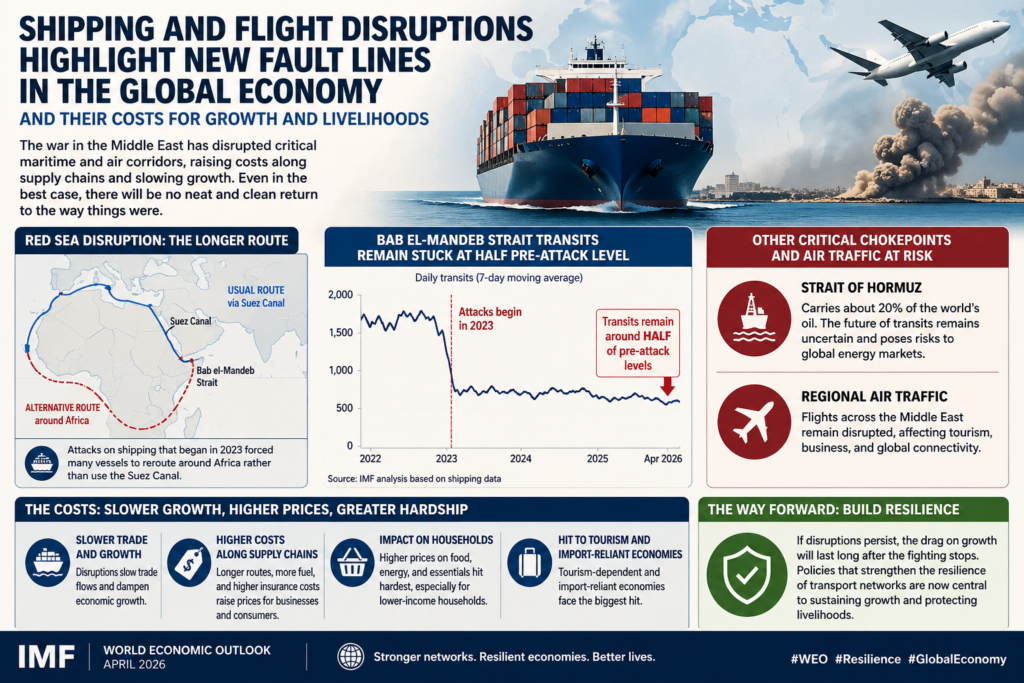
At the center of the crisis is the Red Sea, a vital artery for global commerce. Since 2023, persistent attacks on commercial vessels have forced shipping companies to abandon traditional routes through the Suez Canal, opting instead for the longer and more expensive journey around the southern tip of Africa. As a result, traffic through the Bab el-Mandeb Strait—situated between Yemen and Djibouti—remains at roughly half of its pre-conflict levels more than two years later.
This rerouting has had a cascading effect across global supply chains. Longer travel distances mean higher fuel costs, delayed deliveries, and increased insurance premiums. These costs don’t stay confined to corporations—they ultimately reach consumers, particularly through higher prices on essential goods like food and energy.
The situation is equally precarious in another strategic chokepoint: the Strait of Hormuz. Responsible for a significant portion of the world’s oil transit, any prolonged disruption here could have severe consequences for global energy markets. Meanwhile, regional air traffic remains unstable, further complicating logistics, tourism, and international business operations.
Even in a best-case scenario where peace is restored, economists warn that the damage has already been done. The IMF’s April 2026 World Economic Outlook highlights that persistent disruptions in shipping and aviation will likely dampen global growth for years to come. Trade flows slow down, supply chains become less efficient, and economies that rely heavily on imports or tourism are hit the hardest.
For everyday people, especially in lower-income households, the impact is immediate and tangible. Rising costs of living—driven by supply shortages and increased transportation expenses—are stretching already tight budgets. In many regions, the price of necessities continues to climb, widening economic inequality.
What makes this moment particularly significant is the long-term shift it signals. If recovery in key transit routes like the Bab el-Mandeb Strait becomes the norm rather than the exception, the global economy may have to adapt to a “new normal” of fragmented trade routes and higher operational costs.
In response, policymakers are being urged to prioritize resilience. That means investing in diversified transport corridors, strengthening infrastructure, and building more adaptable supply chains that can withstand geopolitical shocks.
The message from global economists is clear: the intersection of conflict and commerce is no longer a distant concern—it is a defining force shaping the future of the global economy.




More Stories
Suspect Arrested in Phoenix Double Homicide Near 16th and McKinley Streets
IMF: Tax Avoidance Crackdowns Are Reshaping Competition for Global Business
ICC Unseals Four Taliban Arrest Warrants Over Alleged Gender Persecution in Afghanistan