



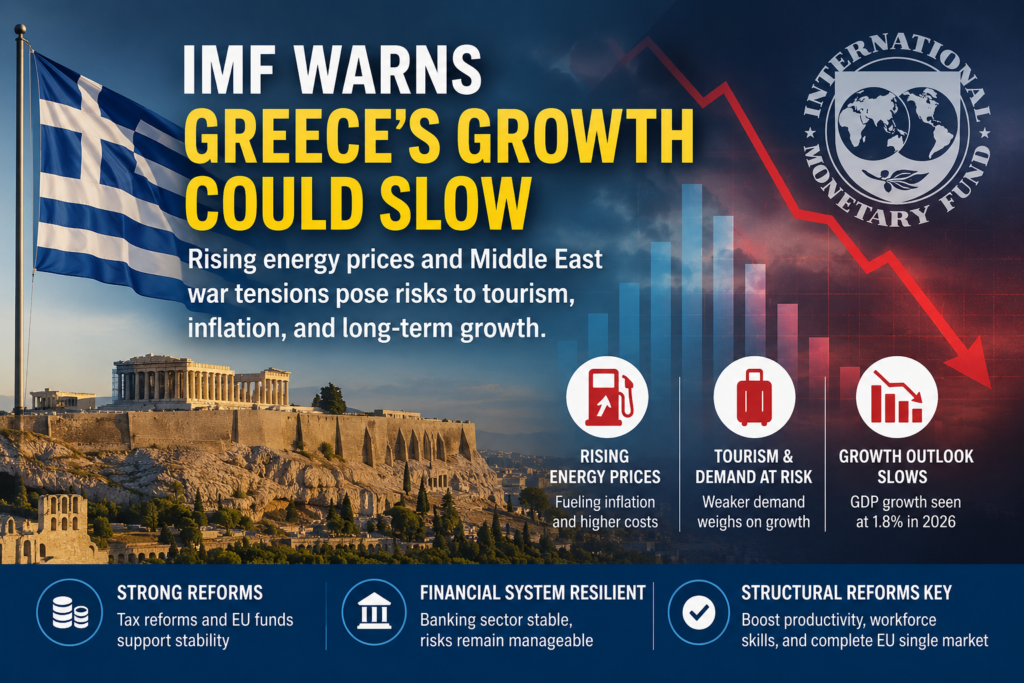
The International Monetary Fund (IMF) says Greece has shown surprising economic resilience despite growing global instability tied to the ongoing war in the Middle East. However, the organization warns that rising energy prices, weaker tourism demand, and geopolitical uncertainty could slow the country’s growth in the coming years.
According to the IMF’s latest Article IV Consultation, Greece managed to maintain fiscal stability and strengthen its banking sector even as global markets faced pressure from escalating conflict overseas. The IMF credited strong public investment, tax reforms, and European Union recovery funding for helping stabilize the economy.
The IMF projects Greece’s GDP growth will slow to 1.8% in 2026 after reaching 2.1% in 2025. While public investment and household support programs are helping soften the blow of higher energy costs, the IMF says inflation and weaker external demand are beginning to weigh heavily on consumers and tourism — two major pillars of the Greek economy.
Officials also warned that prolonged geopolitical conflict or further fragmentation of global trade could create additional economic instability. The IMF noted that energy prices remain one of the biggest threats to Greece’s economic outlook.
The report praised Greece for reducing tax evasion and broadening its tax base, saying those reforms helped create financial flexibility for temporary support programs aimed at helping households manage rising living costs. Public debt levels are also projected to continue declining, though they remain among the highest in Europe.
The IMF’s 2026 Financial Sector Assessment Program — the first such review since 2006 — found that Greece’s banking system remains resilient and capable of handling economic shocks. However, IMF officials urged continued monitoring of financial risks and recommended stronger safeguards for distressed debt and banking oversight.
The organization also emphasized the importance of long-term structural reforms, including digital transformation, workforce development, and completing the European Union single market. The IMF believes those reforms are critical to increasing productivity and reducing Greece’s persistent trade deficits.
The report highlighted demographic concerns as well, warning that Greece’s declining working-age population and low labor participation rates could slow economic growth in the future unless major labor and productivity reforms are implemented.
While the IMF acknowledged that Greece has made major progress compared to previous financial crises, it stressed that the country still faces significant challenges tied to inflation, energy security, and global instability.
The full report comes as Europe continues navigating economic uncertainty caused by geopolitical tensions, energy market disruptions, and concerns about long-term recession risks across several major economies.




More Stories
Suspect Arrested in Phoenix Double Homicide Near 16th and McKinley Streets
IMF: Tax Avoidance Crackdowns Are Reshaping Competition for Global Business
ICC Unseals Four Taliban Arrest Warrants Over Alleged Gender Persecution in Afghanistan