


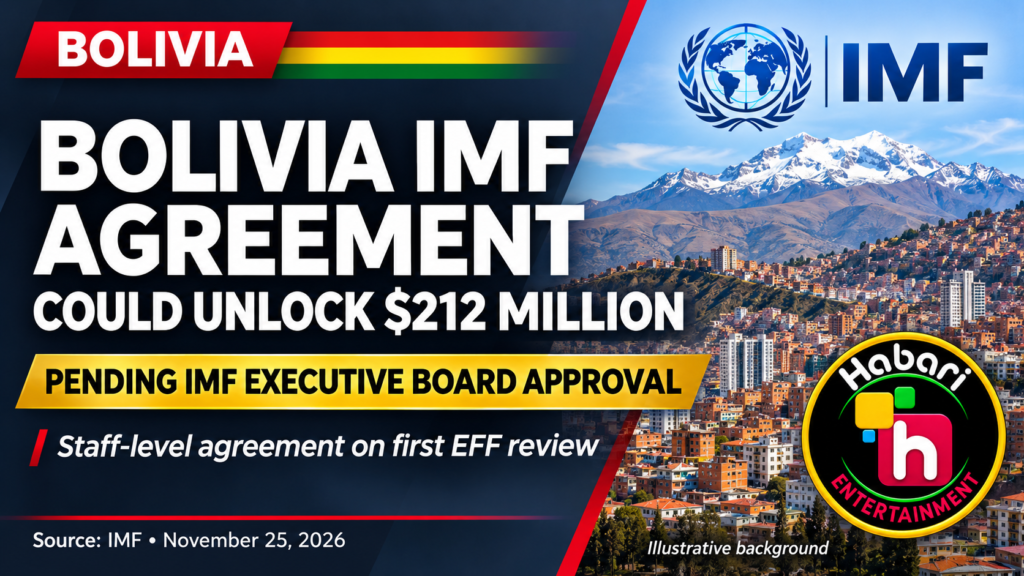
WASHINGTON — Bolivia and International Monetary Fund staff have reached an agreement on the first review of the country’s economic reform program, potentially providing access to approximately $212 million, the IMF announced November 25.
The agreement remains subject to IMF Executive Board approval. It covers policies and reforms under Bolivia’s 36-month Extended Fund Facility arrangement.
An IMF team led by Fabián Valencia held discussions with Bolivian authorities in La Paz from October 29 through November 14, 2026.
IMF Staff Reports Strong Program Performance
According to the statement, Bolivia met all end-September quantitative targets that could be assessed, several by substantial margins.
International reserves and the nonfinancial public sector’s primary balance performed better than program targets. However, staff could not assess the target concerning changes in floating debt because of insufficient data.
The authorities also implemented all end-October structural benchmarks and completed one end-December benchmark ahead of schedule.
Inflation Falls as Fiscal and External Positions Improve
IMF staff said Bolivia has made progress toward restoring economic stability despite high global energy prices.
Inflation has declined to single digits, international reserves are being rebuilt, and the transition to a flexible exchange-rate regime has remained orderly, according to the assessment.
Staff attributed those improvements to fiscal and monetary restraint, expanded social protections, an end to new central bank financing of the fiscal deficit, reductions in inefficient fuel subsidies, and steps to improve access to credit.
The authorities are also working to strengthen financial risk monitoring, the institutional framework of Bolivia’s central bank and liquidity management.
Economic Rebound Expected From Second Half of 2027
Economic activity is expected to rebound beginning in the second half of 2027, IMF staff said.
Inflation could temporarily increase because of fuel-price adjustments before resuming its decline. The current account is projected to remain in surplus, supported by strong mining exports.
Staff cautioned that substantial risks remain. Higher global energy prices, climate shocks or renewed social unrest could weaken growth, strain public finances and slow reforms.
Stronger mining and agricultural commodity prices, private investment and employment could improve the outlook beyond current projections.
Social Protection and Financial Reforms Remain Priorities
The IMF team emphasized the need to protect vulnerable households while maintaining economic reforms.
Better-targeted spending could create room for social programs and public investment. Staff also called for timely clearance of payment arrears, stronger public financial management, and continued efforts to reduce inflation.
Further reforms to financial-sector resilience, governance and the business environment would help support a lasting recovery and job creation, according to the statement.
The staff-level agreement is a preliminary step. The review must receive management approval before being presented to the Executive Board for a decision.
Source: IMF staff statement dated November 25, 2026. Staff assessments do not necessarily represent the views of the IMF Executive Board.




More Stories
Two Columbia Businesses Cited After Illinois State Police Underage Alcohol Checks
LAPD Seeks Driver After Hit-and-Run Severely Injures Woodland Hills Bicyclist
Phoenix Children’s to Lead 2026 APS Electric Light Parade on December 5