


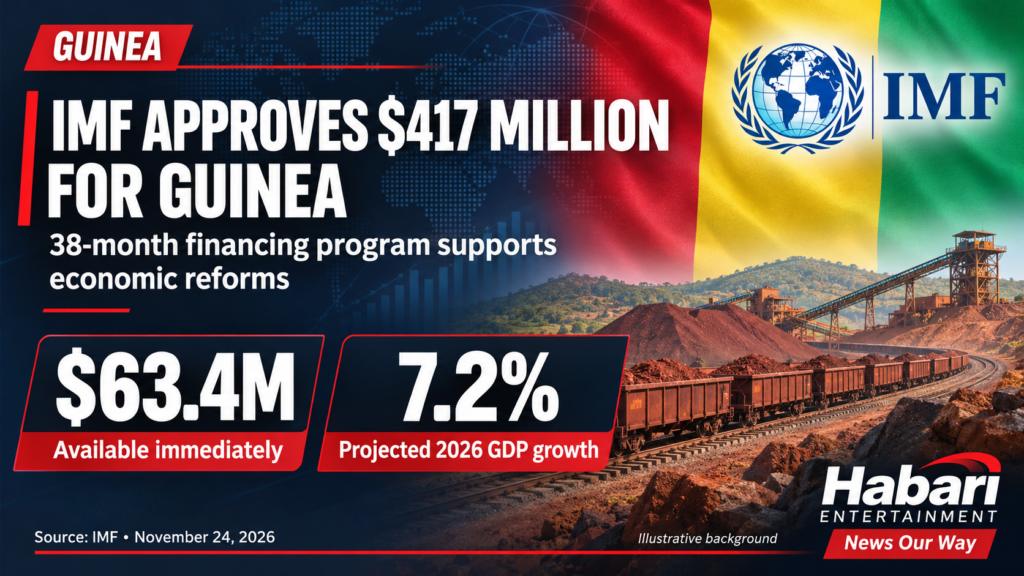
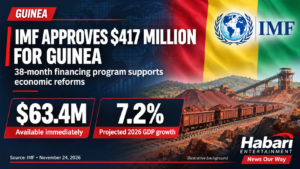
WASHINGTON — The International Monetary Fund has approved approximately $417 million in financing for Guinea, supporting a reform program aimed at strengthening public finances, rebuilding foreign reserves and turning mining-led growth into broader improvements in living standards.
The IMF Executive Board approved the 38-month program on November 23, according to a November 24 announcement. The decision allows an immediate disbursement of approximately $63.4 million, which Guinea’s authorities intend to use for budget support.
The remaining financing will be available in six equal installments, subject to semiannual reviews.
Financing Supports Economic Reforms
The package combines approximately $139.1 million under the Extended Credit Facility with $278.1 million under the Extended Fund Facility. The board also concluded Guinea’s 2026 Article IV consultation, its periodic assessment of the country’s economy.
The program centers on collecting more domestic revenue, particularly from mining, improving public spending and managing liquidity more effectively.
The IMF said Guinea’s economy has remained resilient despite repeated shocks. However, inflationary pressures, persistent cash shortages and limited external reserves require sustained policy action.
Simandou Project Strengthens Growth Outlook
Guinea’s economy is projected to grow 7.2 percent in 2026, following estimated growth of 6.9 percent in 2025. Growth is forecast to reach 7.8 percent in 2027, then exceed 10 percent in 2028 and 2029 as mining production expands.
The Simandou iron ore project is a central driver of that outlook. The IMF emphasized that stronger mining activity must translate into development beyond the extractive sector.
“Strong mining expansion and investment related to the Simandou project have helped Guinea’s economy remain resilient despite repeated shocks,” said IMF Deputy Managing Director and Acting Chair Bo Li.
He cautioned that significant risks and substantial development needs remain.
IMF Calls for Stronger Revenue Collection and Spending Controls
The program seeks to narrow Guinea’s fiscal deficit while protecting priority social programs and investment.
The IMF recommended stronger mining revenue collection, modernized tax and customs administration, and improved public investment management. It also called for tighter controls on spending outside the budget and measures to prevent unpaid government obligations from accumulating.
Gradually reducing fuel and electricity subsidies, accompanied by targeted support for vulnerable households, could create additional room for priority spending, the IMF said.
The fiscal deficit, including grants, is projected to decline from 6.4 percent of GDP in 2025 to 3.7 percent in 2026.
Cash Shortages and Inflation Remain Priorities
Average inflation is projected to rise from 3.1 percent in 2025 to 6.3 percent in 2026, before easing to 5.8 percent in 2027.
The IMF said monetary policy should remain prudent, with further tightening if necessary. It also recommended greater exchange-rate flexibility and clearer rules for foreign-exchange intervention to help rebuild reserves.
Addressing persistent cash shortages is another immediate priority. Recommended measures include improving banknote availability and distribution, strengthening public communication and expanding digital payments.
The IMF also urged closer supervision of banks, particularly given their growing exposure to government debt.
Transparency and Social Investment Central to Program
The IMF called for mining revenues and related financial obligations to be transparently recorded in Guinea’s budget and fiscal framework.
Other priorities include stronger anti-corruption measures, public procurement safeguards, financial transparency and protections against money laundering and terrorist financing.
Investment in education, health, social protection and the business environment will be important to expanding opportunities beyond mining, according to the assessment.
Guinea’s Economic Outlook
| Indicator | 2025 estimate | 2026 projection | 2027 projection |
|---|---|---|---|
| Real GDP growth | 6.9% | 7.2% | 7.8% |
| Average inflation | 3.1% | 6.3% | 5.8% |
| Fiscal balance, including grants | −6.4% of GDP | −3.7% | −3.5% |
| Total public debt | 38.7% of GDP | 39.1% | 38.0% |
| Gross available reserves | 1.8 months of imports | 2.6 months | 3.2 months |
Reserve projections assume the remaining balance-of-payments financing gap is filled and use the IMF’s specified import-coverage measure.
The IMF identified commodity-price changes, financing conditions and institutional constraints as risks to the outlook. Successful implementation will depend on sustained reforms, realistic sequencing and coordination with development partners.
Source: IMF announcement dated November 24, 2026. Economic figures are IMF staff estimates and projections.



More Stories
Motorcyclist Killed in Crash at 44th Street and Bell Road in Phoenix
Phoenix’s El Pavazo Event Planned Thanksgiving Turkey Giveaway for District 5 Families
ICC Unveils Bust of Rafał Lemkin Honoring His Contribution to Genocide Law