





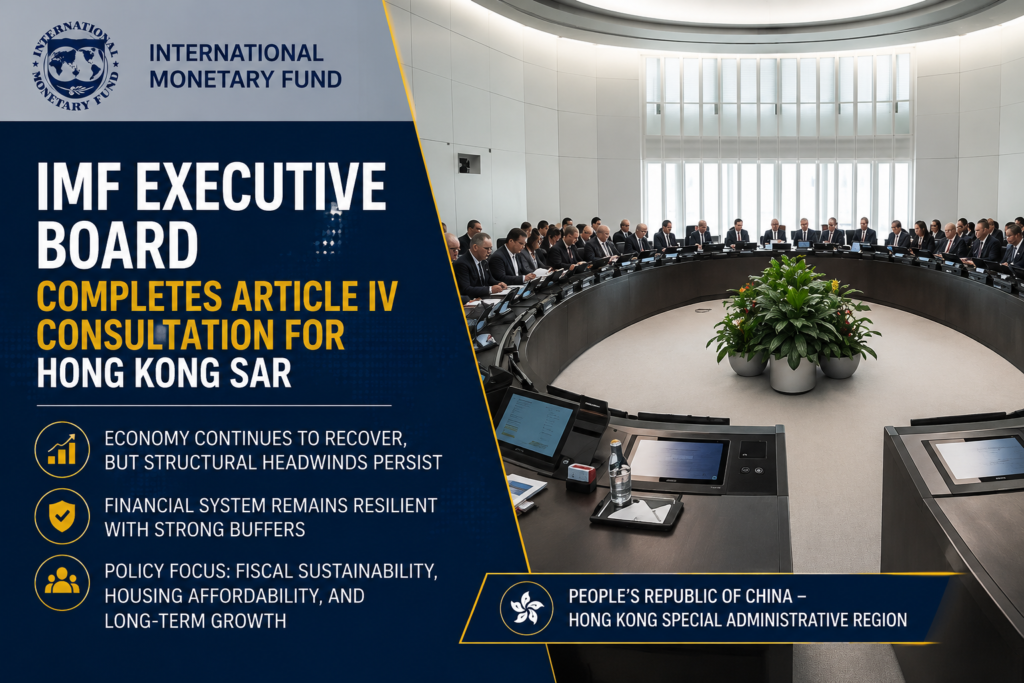
Washington, DC: The Executive Board of the International Monetary Fund (IMF) completed the Article IV Consultation for the People’s Republic of China—Hong Kong Special Administrative Region (SAR) and considered and endorsed the staff appraisal without meeting on a lapse-of-time basis.[1],[2] The authorities have consented to the publication of the Staff Report prepared for this consultation.[3]
Hong Kong SAR’s economy has continued to recover, with growth in 2025 stronger than expected, supported by robust technology-related exports, improving private demand, and a rebound in financial market activity. The territory has further reinforced its role as a global financial center and a key super-connector between the Chinese mainland and the rest of the world. However, the recovery remains incomplete: economic activity is still below its pre-pandemic trend, while headwinds persist—notably weak private investment and declining labor force participation, both still below pre-pandemic levels. The banking system remains resilient, underpinned by strong capital, ample liquidity, and solid profitability, although asset quality pressures persist in some segments, particularly domestic commercial real estate exposures, which represent the principal near-term financial risk.
Near-term growth is expected to moderate, reflecting weaker external demand and tighter financial conditions amid the war in the Middle East.[4] Over the medium term, declining youth labor force participation and population aging are expected to weigh on labor supply and potential growth, projected at around 2¼ percent. In response, the authorities are advancing efforts to develop new growth drivers, including through long-term investment in the Northern Metropolis to foster innovation and technology. The outlook remains subject to downside risks, given Hong Kong SAR’s high exposure to geopolitical and trade tensions, global financial volatility, and a potential slowdown in the technology cycle.
Executive Board Assessment
Hong Kong SAR’s economy has continued to recover, supported by strong exports and financial market activity, although the recovery remains uneven with persistent slack and structural headwinds. Real GDP surpassed its pre-pandemic peak in 2025, and the financial system remains resilient, with banks well capitalized, liquid, and profitable, and the LERS continuing to operate smoothly as a credible anchor for stability. The external position in 2025 was broadly in line with the level implied by medium-term fundamentals and desirable policies. However, economic activity remains below its pre-pandemic trend, with persistent slack, weak private investment, and declining labor force participation. While residential property markets have stabilized, CRE continues to face structural headwinds, and deeper integration with the Mainland presents opportunities and exposure to regional risks.
Growth is expected to moderate, with risks tilted to the downside amid elevated global uncertainty and domestic vulnerabilities. In the near term, the impact of the war in the Middle East on trade partner growth and global financial conditions is expected to weigh on activity, with medium-term growth stabilizing at a lower rate. Downside risks stem from an intensification of geopolitical tensions, further tightening of financial conditions, and potential disruptions to trade and financial flows, which could transmit rapidly through Hong Kong SAR’s highly open and interconnected economy, particularly affecting vulnerable sectors such as CRE and SMEs. Domestic risks also arise from persistent vulnerabilities in CRE, where further price declines could adversely affect banks and the broader economy. Upside risks include stronger productivity gains from AI and faster implementation of strategic investment projects.
Financial sector risks appear manageable, supported by strong buffers and robust regulatory oversight, but continued vigilance is warranted. Maintaining banking sector resilience will require sustained supervisory focus on exposures to highly leveraged corporates, particularly in real estate and SMEs. Timely recognition of expected credit losses and adequate provisioning remain essential. Remaining SME support measures should be carefully targeted to ease liquidity strains without distorting credit allocation or delaying necessary restructuring of non-viable firms. Macroprudential measures related to residential real estate exposures remained unchanged in 2025, which appears appropriate given the stabilization in market conditions, mortgage credit, and asset quality. In CRE, declining collateral values and refinancing pressures warrant continued prudent underwriting, sound valuation practices, and capital buffers commensurate with risks. Expanding system-wide stress testing would further enhance macroprudential oversight, particularly as the NBFI sector evolves.
The fiscal stance in 2026 is appropriate, but stronger medium-term consolidation is needed to address spending pressures and rebuild fiscal reserves. The incomplete recovery in domestic demand supports maintaining an expansionary stance in the near term. Over the medium term, however, consolidation plans may be insufficient to address rising spending pressures from population aging, social protection needs, and large infrastructure investments. Broader revenue reforms will therefore be needed to strengthen and stabilize the revenue base and reduce reliance on cyclical revenue sources, while preserving growth-enhancing investment.
Improving housing affordability will require a sustained expansion of public housing supply and better targeting of existing programs. While conditions in parts of the private residential market have stabilized, demand for public housing remains elevated, and delivery has lagged targets. Authorities’ ongoing efforts to scale up public housing production will be critical to reducing waiting times, while stronger enforcement of eligibility criteria and measures to curb misuse will improve allocation efficiency.
Hong Kong SAR is well-positioned to advance its digital and sustainable finance agenda, supported by strong regulatory frameworks and ongoing initiatives such as Fintech 2030. Continued adherence to the “same activity, same risk, same regulation” principle, enhanced cross-sectoral coordination, and improved data collection will be important to manage emerging risks, including from crypto assets and tokenization. At the same time, continued attention to operational and cyber risks remains critical. Advancing climate finance will require scaling up private capital mobilization, supported by high-quality implementation of sustainability disclosure standards and robust frameworks to mitigate greenwashing risks.
In an increasingly fragmented global environment, Hong Kong SAR’s role as a super-connector remains central to sustaining its competitiveness. Continued development as a leading offshore RMB hub, deeper integration with the Mainland through Connect schemes, and strong legal and regulatory frameworks will support its role in global finance and trade. Strategic initiatives, including the Greater Bay Area and the Northern Metropolis, can further strengthen cross-border integration, support innovation, and promote high-value-added services.
Industrial policy can support diversification and innovation, but should be approached with caution. Any strategy should be grounded in clearly identified market failures and supported by strong governance, transparency, and regular evaluation. Support should be time-bound, targeted, and maintain open access to ensure that resources are directed toward commercially viable investments and that policies achieve their intended objectives.
Addressing the decline in labor force participation will require coordinated policy efforts to mitigate demographic pressures and structural headwinds. Policies should focus on encouraging greater participation among older workers and women, strengthening education and training systems to reduce skills mismatches, and supporting reskilling and job transitions in the face of technological change. Enhancing labor market flexibility and improving job matching will be key to sustaining inclusive growth.
| Hong Kong SAR—Selected Economic and Financial Indicators, 2021–31 | |||||||||||
| 2021 | 2022 | 2023 | 2024 | 2025 | 2026 | 2027 | 2028 | 2029 | 2030 | 2031 | |
| Prel. | Proj. | ||||||||||
| NATIONAL ACCOUNTS | |||||||||||
| Real GDP (percent change) | 6.5 | -3.7 | 3.2 | 2.6 | 3.5 | 2.4 | 2.4 | 2.3 | 2.3 | 2.2 | 2.2 |
| Private consumption | 5.6 | -2.2 | 6.8 | -0.2 | 1.7 | 1.7 | 1.7 | 2.1 | 2.1 | 2.1 | 2.1 |
| Government consumption | 5.9 | 8.0 | -3.9 | 0.7 | 1.6 | 1.1 | 0.6 | 0.1 | -0.1 | -0.3 | -0.4 |
| Gross fixed capital formation | 8.3 | -7.4 | 11.4 | 1.9 | 4.3 | 7.2 | 1.3 | 0.7 | 0.5 | 1.4 | 1.3 |
| Inventories (contribution to growth) | -1.9 | -0.7 | 0.1 | 0.2 | 1.9 | -1.2 | 0.0 | 0.0 | 0.0 | 0.0 | 0.0 |
| Net exports (contribution to growth) | 2.7 | -1.2 | -2.7 | 2.1 | -0.4 | 1.1 | 0.9 | 0.8 | 0.8 | 0.6 | 0.6 |
| Output gap (in percent of potential GDP) | -2.3 | -4.1 | -3.9 | -4.0 | -2.6 | -2.2 | -1.6 | -1.2 | -0.7 | -0.3 | 0.0 |
| LABOR MARKET | |||||||||||
| Employment (percent change) | -0.6 | -1.6 | 2.7 | -0.4 | -0.6 | 0.0 | -0.1 | 0.0 | 0.2 | 0.2 | 0.4 |
| Unemployment rate (percent, period average) | 5.2 | 4.3 | 2.9 | 3.0 | 3.7 | 3.3 | 3.2 | 3.0 | 2.8 | 2.7 | 2.7 |
| Real wages (percent change) | -0.5 | -1.4 | 1.4 | 1.5 | 1.7 | 1.1 | 0.8 | 1.1 | 1.2 | 1.3 | 1.3 |
| PRICES | |||||||||||
| Inflation (percent change) | |||||||||||
| Consumer prices | 1.6 | 1.9 | 2.1 | 1.7 | 1.4 | 2.1 | 1.8 | 2.1 | 2.2 | 2.4 | 2.5 |
| GDP deflator | 0.7 | 1.7 | 2.9 | 4.2 | 1.0 | 2.7 | 1.9 | 2.1 | 2.3 | 2.4 | 2.5 |
| GENERAL GOVERNMENT | |||||||||||
| Consolidated budget balance (percent of GDP) 1/ | 0.0 | -6.7 | -5.8 | -5.9 | -4.9 | -5.3 | -3.3 | -1.4 | -0.8 | -0.8 | -0.8 |
| Revenue | 24.2 | 22.1 | 18.4 | 17.7 | 18.8 | 18.1 | 20.0 | 20.5 | 20.9 | 20.9 | 20.9 |
| Expenditure | 24.2 | 28.9 | 24.2 | 23.6 | 23.7 | 23.4 | 23.3 | 21.9 | 21.7 | 21.7 | 21.7 |
| Fiscal reserves (as of end-March, percent of GDP) | 33.4 | 29.7 | 24.6 | 20.5 | 19.7 | 20.0 | 20.1 | 20.4 | 20.4 | 20.4 | 20.3 |
| FINANCIAL 2/ | |||||||||||
| Interest rates (percent, period average) | |||||||||||
| Best lending rate | 5.0 | 5.1 | 5.8 | 5.8 | 5.2 | … | … | … | … | … | … |
| Three-month HIBOR | 0.2 | 2.1 | 4.6 | 4.5 | 3.1 | … | … | … | … | … | … |
| 10-year Treasury bond yield | 1.2 | 2.8 | 3.6 | 3.4 | 3.2 | … | … | … | … | … | … |
| MACRO-FINANCIAL 2/ | |||||||||||
| Loans for use in Hong Kong SAR (excl. trade financing) | 4.3 | 0.9 | -0.4 | -2.1 | 1.9 | … | … | … | … | … | … |
| House prices (year-on-year percent change for last quarter) | 3.7 | -15.0 | -7.0 | -7.1 | 3.6 | … | … | … | … | … | … |
| EXTERNAL SECTOR | |||||||||||
| Merchandise trade (percent change) | |||||||||||
| Export value | 26.3 | -8.6 | -7.8 | 8.7 | 15.3 | 12.6 | 4.7 | 3.4 | 3.8 | 3.6 | 3.6 |
| Import value | 24.3 | -7.2 | -5.7 | 6.0 | 15.5 | 12.4 | 4.4 | 3.2 | 3.5 | 3.5 | 3.5 |
| Current account balance (= S-I balance, percent of GDP) | 11.8 | 10.2 | 8.4 | 13.1 | 12.2 | 12.6 | 12.3 | 12.1 | 11.9 | 11.5 | 11.4 |
| Gross capital formation (percent of GDP) | 16.8 | 15.2 | 16.2 | 16.1 | 18.3 | 18.8 | 19.2 | 19.7 | 20.4 | 20.9 | 21.1 |
| Gross national savings (percent of GDP) | 28.6 | 25.4 | 24.6 | 29.2 | 30.6 | 31.4 | 31.5 | 31.8 | 32.3 | 32.4 | 32.5 |
| Foreign exchange reserves | |||||||||||
| In billions of U.S. dollars (end-of-period) | 497 | 424 | 426 | 422 | 428 | 468 | 499 | 527 | 558 | 592 | 649 |
| In percent of GDP | 135 | 118 | 112 | 103 | 100 | 104 | 106 | 107 | 109 | 110 | 115 |
| Net international investment position (percent of GDP) | 574 | 492 | 461 | 490 | 586 | 569 | 558 | 546 | 534 | 522 | 510 |
| EXCHANGE RATE | |||||||||||
| Market rate (HK$/US$, period average, derived from monthly average) | 7.773 | 7.831 | 7.830 | 7.804 | 7.797 | … | … | … | … | … | … |
| Real effective rate (period average, 2010=100) | 111.5 | 115.6 | 119.4 | 122.4 | 122.0 | … | … | … | … | … | … |
| Sources: Haver Analytics; BIS, CEIC; HKSAR Census and Statistics Department; and IMF staff estimates.
1/ Staff’s baseline projections for FY2026/27 onwards. Before issuance and repayment of government bonds and notes. Transfers from the Exchange Fund (around 4 percent of GDP, split evenly between FY2026/27 and FY2027/28), Bond Fund (1.1 percent of GDP in FY2026/27), and funds outside the government accounts (0.5 percent of GDP in FY2026/27) are treated as below-the-line items. 2/ Using the latest data available. 3/ Based on loans for use in Hong Kong SAR, excluding trade financing. |
|||||||||||
[1] The Executive Board takes decisions under its lapse‑of‑time procedure when the Board agrees that a proposal can be considered without convening formal discussions.
[2] Under Article IV of the IMF’s Articles of Agreement, the IMF holds bilateral discussions with members, usually every year. At the request or with the consent of the member, IMF staff may hold separate discussions with respect to territories or constituent parts of a member. These Article IV consultation discussions form a part of the member’s Article IV consultation. In such cases, a staff team visits the territory or constituent part, collects economic and financial information, and discusses with officials the territory’s or constituent part’s economic developments and policies. On return to headquarters, the staff prepares a report, which forms the basis for discussion by the Executive Board, which in turn constitutes an integral part of the member’s AIV consultation for the relevant cycle.
[3] Under the IMF’s Articles of Agreement, publication of documents that pertain to member countries is voluntary and requires the member’s consent. The staff report will be published shortly on the IMF Country page.
[4] The staff appraisal and projections are based on data available through April 2026. See the IMF Country page for the latest projections.




More Stories
Star Meat Delivery Inc. Recalls More Than 167,000 Pounds of Meat Over Inspection and USDA Mark Concerns
Four People Reportedly Shot in Mesa; Person of Interest Detained
When Food Prices Surge, Governments Must Choose Relief Programs Carefully