





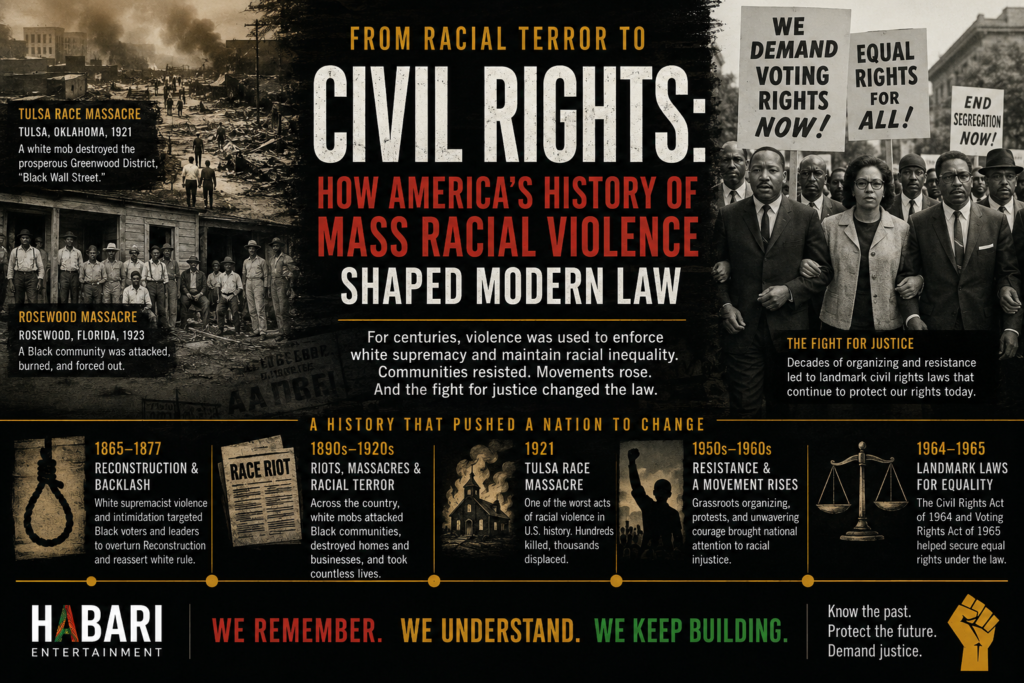
The story of civil rights in the United States cannot be told without confronting the nation’s long history of racial violence. From Reconstruction through the Civil Rights Movement, racial terror, massacres, expulsions, and mob violence were often used to enforce racial hierarchies and suppress the political and economic advancement of minority communities.
Historical records show that many of the most significant incidents of mass racial violence in American history involved white mobs targeting Black Americans, Native Americans, Asian Americans, and other minority groups. These attacks were not isolated incidents. They were frequently connected to struggles over political power, voting rights, economic competition, and efforts to maintain systems of racial inequality.
Following the Civil War, formerly enslaved African Americans gained new political rights during Reconstruction. In response, white supremacist organizations and mobs used violence to intimidate Black voters, remove elected officials, and restore white political control throughout much of the South. Historians have documented that violence became a central tool in undermining Reconstruction and limiting Black political participation.
Throughout the late nineteenth and early twentieth centuries, racial violence spread across the country. The Wilmington Insurrection of 1898 remains the only successful coup d’état in United States history, when white supremacists overthrew a legitimately elected local government in North Carolina. Other incidents included the Atlanta Race Massacre of 1906, the Springfield Race Riot of 1908, the Red Summer of 1919, and numerous attacks that forced Black families from entire communities.
Perhaps the most infamous example was the Tulsa Race Massacre of 1921. A white mob attacked the prosperous Greenwood District of Tulsa, Oklahoma, often called “Black Wall Street.” Homes, businesses, churches, and schools were destroyed. Hundreds of residents were injured, thousands were left homeless, and historians consider it one of the worst incidents of racial violence in American history.
Other communities suffered similar fates. In Rosewood, Florida, a predominantly Black town was destroyed by a white mob in 1923. Across the country, racial violence was often accompanied by lynchings, voter suppression, segregation, and discriminatory laws designed to maintain racial inequality.
The consequences extended far beyond the immediate loss of life and property. Entire generations lost wealth, educational opportunities, political influence, and economic security. Many families fled their homes and communities, contributing to migration patterns that reshaped American cities throughout the twentieth century.
Yet these acts of violence also helped inspire movements for justice. The brutality experienced by Black Americans and other marginalized communities became impossible to ignore. Activists, journalists, clergy members, and community leaders documented abuses and demanded federal action.
The Civil Rights Movement of the 1950s and 1960s emerged from decades of organizing against segregation, disenfranchisement, and racial violence. Images of attacks on peaceful protesters, bombings, and racial terror galvanized national attention and increased pressure for legislative change. The movement ultimately helped secure landmark protections including the Civil Rights Act of 1964 and the Voting Rights Act of 1965.
Modern civil rights laws did not emerge in a vacuum. They were shaped by generations of Americans who endured intimidation, discrimination, and violence while demanding equal treatment under the law. Understanding this history helps explain why protections for voting rights, equal access, fair housing, and equal protection remain central to American democracy.
The legacy of mass racial violence continues to influence conversations about race, justice, policing, voting rights, and economic inequality today. While the nation has made significant progress, examining these events honestly allows Americans to better understand both the origins of civil rights protections and the work that remains.
History is not simply a record of past injustice. It is also a reminder of how communities resisted oppression, organized for change, and transformed the law in pursuit of a more equal society.




More Stories
Phoenix Police Investigate Double Homicide Near 16th Street and McKinley Street
IMF: Tax Avoidance Crackdowns Are Reshaping Competition for Global Business
ICC Unseals Four Taliban Arrest Warrants Over Alleged Gender Persecution in Afghanistan