


February 6, 2026
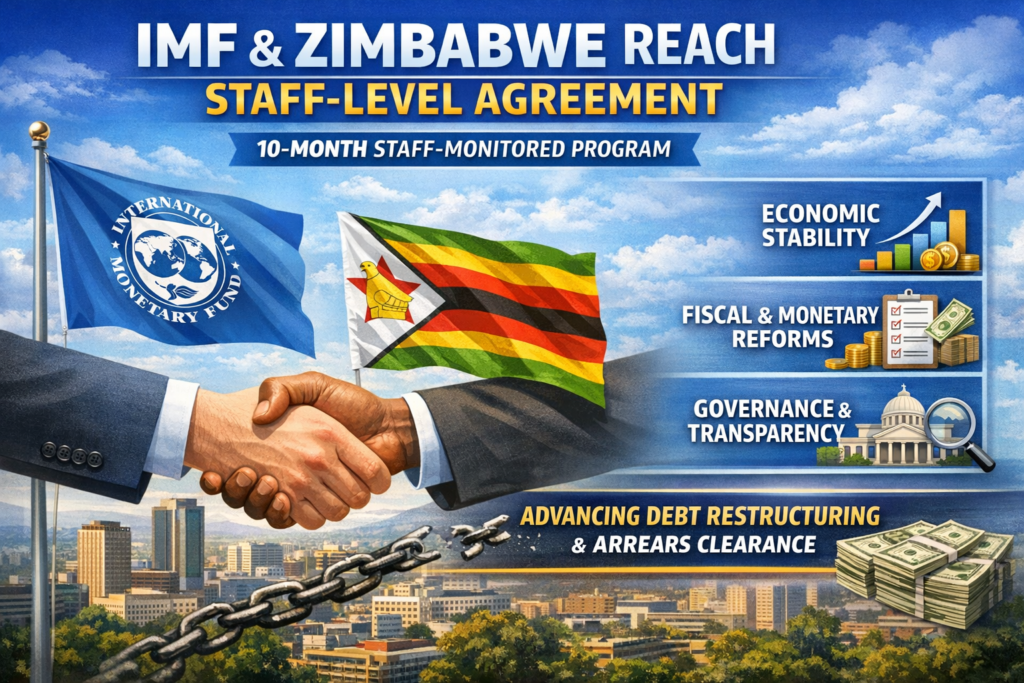
- The IMF and Zimbabwe have reached a staff-level agreement on economic policies and reforms to be monitored under a 10-month Staff-Monitored Program (SMP), aimed at consolidating recent stabilization gains and strengthening macroeconomic management.
- The program emphasizes prudent budget execution, improved cash and expenditure controls, sustained monetary discipline, and governance reforms to enhance transparency and manage fiscal risks. It also supports the authorities’ social protection efforts.
- The SMP forms part of Zimbabwe’s broader strategy to build a credible reform track record and advance Zimbabwe’s re-engagement with the international community on arrears clearance and debt restructuring, under the Structured Dialogue Platform.
Harare: An International Monetary Fund (IMF) staff team led by Mr. Wojciech Maliszewski held discussions with the Zimbabwean authorities in Harare from January 28 to February 6, 2026. Discussions focused on ongoing policies and reforms to support a Staff-Monitored Program (SMP) that would help entrench macroeconomic stability, strengthen policy credibility, and advance the authorities’ broader re-engagement efforts towards arrears clearance and debt restructuring. This staff-level agreement is subject to IMF Management approval.
At the conclusion of the discussions, Mr. Maliszewski issued the following statement:
“We are pleased to announce that the Zimbabwean authorities and the IMF team have reached a staff-level agreement on the key economic policies and reforms that could underpin a Staff-Monitored Program (SMP), as outlined in the National Development Strategy 2 (NDS2). The proposed 10-month program seeks to consolidate recent stabilization gains, further strengthen fiscal and monetary policy frameworks, improve foreign exchange market functioning, and advance governance reforms to support stronger and more inclusive growth.
“Zimbabwe’s economic recovery continues, supported by tight monetary policy, improving fiscal discipline, and favorable external conditions. Growth strengthened in 2025, surpassing the initial projection of 6.6 percent with solid performances in agriculture and mining, boosted by high gold prices and recovering platinum and lithium output. Inflation fell to 4.1 percent in January 2026, aided by exchange rate stability and tight monetary conditions. Fiscal revenues also strengthened in 2025, supported by improved tax administration and new measures, narrowing the deficit and producing a small primary surplus.
“Looking ahead, growth in 2026 is projected at around 5 percent, supported by continued strength in agriculture and mining. Inflation is expected to remain in single digits, reflecting tight monetary conditions and a more stable foreign exchange market. The current account is projected to remain in surplus at about 3.8 percent of GDP, while the primary fiscal balance is expected to register a surplus of about half a percent of GDP.
“Building on this progress, continued efforts will help entrench stability, deepen confidence in the ZiG, enhance the functioning of the foreign exchange market, sustain the rebuilding of reserve buffers, and reinforce the policy and institutional foundations for durable and broad-based growth.
“The program supports the authorities’ commitment to prudent budget execution and sound expenditure control. In line with the 2026 budget, spending in the first half of the year will be anchored on a conservative revenue outlook, helping ensure that expenditure remains aligned with available resources and avoiding the accumulation of new domestic arrears. To reinforce fiscal discipline and transparency, the authorities will strengthen domestic arrears monitoring through regular reporting and clearer institutional responsibilities.
“Improving cash planning and public financial management is another important element of the program. The authorities will enhance institutional arrangements for cash management and improve short-term liquidity forecasting to support more predictable and credible budget execution. Over time, broader public financial management (PFM) reforms—including upgrades to budget controls, improved capture of commitments, and steps toward a Treasury Single Account—will help strengthen the efficiency, transparency, and discipline of public spending.
“The program will support efforts to maintain low and stable inflation and preserve progress in easing pressures in the foreign exchange market. It will also help lay the foundations for further strengthening the monetary policy framework, including through measures to promote demand for the ZiG, enhance monetary policy operations, and improve foreign exchange (FX) market efficiency.
“The program also supports structural reforms to strengthen governance and improve the management of fiscal risks. Following the publication of the inaugural financial statement, the Mutapa Investment Fund will take further steps to enhance transparency by publishing audited financial statements for all state-owned enterprises under its portfolio in line with the Public Financial Management Act. Mutapa Investment Fund will also continue refraining from contracting debt without the prior written approval of the Ministry of Finance, Economic Development, and Investment Promotion.
“In addition, the program supports the authorities’ efforts to strengthen social protection. As part of this, the Zimbabwe Social Registry (ZISO) will be fully operationalized to improve the targeting and delivery of social assistance, helping ensure that support reaches households most in need.
“The SMP is intended to establish a credible track record that supports the authorities’ re-engagement efforts and complements their broader strategy toward arrears clearance and debt restructuring, including eventual access to external concessional financing. Continued progress on reforms, together with strengthened policy credibility and improved transparency, would help lay the groundwork for more substantive discussions with international partners on arrears-clearance and debt restructuring modalities in the near term.
“The IMF staff team expresses sincere appreciation to the Zimbabwean Authorities for the constructive dialogue, warm hospitality, and strong cooperation. We look forward to continued close engagement as the authorities advance the agreed reform agenda.”



More Stories
ICC Deputy Prosecutor concludes mission to Nigeria, signing a Memorandum of Understanding to enhance complementarity
The ASP President expresses concern over recent media reports regarding the ongoing disciplinary process involving the ICC Prosecutor
ICC hosts Focal Points Retreat of Asia-Pacific Academic Forum